
50 vs 100 vs 200 Beds: Which Hospital Size Should You Build?
October 21, 2026Hospital Fire Safety in India: NBC & NABH Design Requirements
October 24, 2026NABH for Ayush Hospitals: The New 1st Edition Standards

NABH Accreditation for Ayush Hospitals: What the New 1st Edition Standards Require
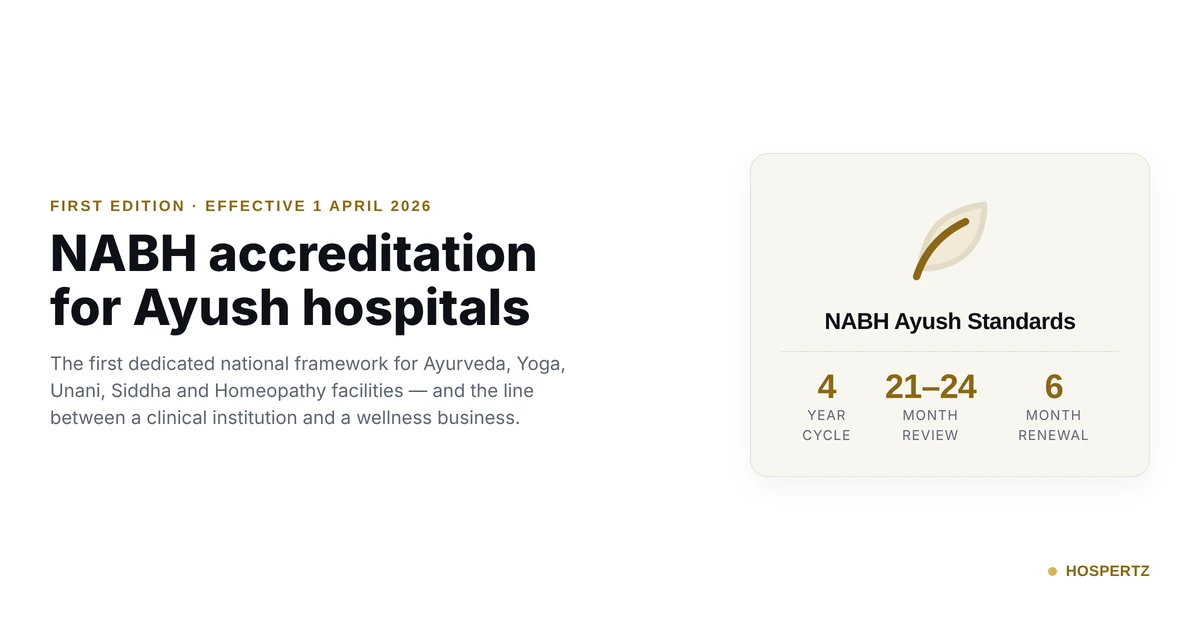
NABH’s first-edition Accreditation Standards for Ayush Hospitals came into effect on 1 April 2026 — the first dedicated national framework for Ayurveda, Yoga, Unani, Siddha and Homeopathy facilities. This guide covers the accreditation cycle, what the standards expect you to demonstrate, and the Panchakarma-specific design requirements facilities discover too late.
class="attachment-full size-full wp-image-7067" alt="" srcset="https://www.hospertz.com/wp-content/uploads/2026/10/vishal-Jadhav-14.png 500w, https://www.hospertz.com/wp-content/uploads/2026/10/vishal-Jadhav-14-300x300.png 300w, https://www.hospertz.com/wp-content/uploads/2026/10/vishal-Jadhav-14-150x150.png 150w, https://www.hospertz.com/wp-content/uploads/2026/10/vishal-Jadhav-14-75x75.png 75w, https://www.hospertz.com/wp-content/uploads/2026/10/vishal-Jadhav-14-480x480.png 480w, https://www.hospertz.com/wp-content/uploads/2026/10/vishal-Jadhav-14-24x24.png 24w, https://www.hospertz.com/wp-content/uploads/2026/10/vishal-Jadhav-14-36x36.png 36w, https://www.hospertz.com/wp-content/uploads/2026/10/vishal-Jadhav-14-48x48.png 48w" sizes="(max-width:767px) 480px, 500px" /> Dr. Vishal Jadhav · Founder, Hospertz
16 October 2026 6 min read
class="attachment-full size-full wp-image-7077" alt="" srcset="https://www.hospertz.com/wp-content/uploads/2026/10/nabh-ayush-hospital-accreditation-standards-2026-hospertz.webp 1200w, https://www.hospertz.com/wp-content/uploads/2026/10/nabh-ayush-hospital-accreditation-standards-2026-hospertz-300x158.webp 300w, https://www.hospertz.com/wp-content/uploads/2026/10/nabh-ayush-hospital-accreditation-standards-2026-hospertz-1024x538.webp 1024w, https://www.hospertz.com/wp-content/uploads/2026/10/nabh-ayush-hospital-accreditation-standards-2026-hospertz-768x403.webp 768w, https://www.hospertz.com/wp-content/uploads/2026/10/nabh-ayush-hospital-accreditation-standards-2026-hospertz-143x75.webp 143w, https://www.hospertz.com/wp-content/uploads/2026/10/nabh-ayush-hospital-accreditation-standards-2026-hospertz-480x252.webp 480w, https://www.hospertz.com/wp-content/uploads/2026/10/nabh-ayush-hospital-accreditation-standards-2026-hospertz-24x13.webp 24w, https://www.hospertz.com/wp-content/uploads/2026/10/nabh-ayush-hospital-accreditation-standards-2026-hospertz-36x19.webp 36w, https://www.hospertz.com/wp-content/uploads/2026/10/nabh-ayush-hospital-accreditation-standards-2026-hospertz-48x25.webp 48w" sizes="(max-width:767px) 480px, (max-width:1200px) 100vw, 1200px" /> In this article
- The first-edition Ayush hospital standards took effect on 1 April 2026, with an AYUSH entry-level certification route for smaller facilities.
- Accreditation runs on a four-year cycle with midterm surveillance at 21–24 months, and renewal must be applied for six months before expiry.
- Wet treatment areas, oil-laden effluent, humidity control and linen logistics are Panchakarma-specific design problems most architects have never met.
- Statutory compliance is a precondition, not part of the assessment — a lapsed licence is an eligibility problem, not a finding.
- Accreditation is becoming the dividing line between clinical institutions and wellness businesses, and it unlocks insurance, corporate panels and medical value travel.
On 1 April 2026, NABH’s first-edition Accreditation Standards for Ayush Hospitals came into effect. For the Ayurveda, Yoga, Unani, Siddha and Homeopathy sector, this is the first time a dedicated national accreditation framework has been available — and it changes what a serious Ayush facility looks like.
If you run or are building an Ayurvedic hospital, a Panchakarma centre, a Homeopathy facility or an integrated wellness hospital, this matters for three reasons: credibility with patients, access to insurance and corporate panels, and eligibility for medical value travel. Accredited status is becoming the dividing line between facilities treated as clinical institutions and those treated as wellness businesses.
Here is what the framework involves.
Why a separate Ayush framework
Allopathic hospitals have had NABH standards since 2006 — now in their 6th edition. Ayush facilities had no equivalent, which created a real problem for the good ones: there was no way to distinguish a rigorously-run Ayurvedic hospital from a resort with a massage room.
NABH has stated that the Ayush standards are developed without being prescriptive, with the interests of various stakeholders incorporated, and that they provide a framework for implementation rather than a rigid template. In practice this means the standards address Ayush-specific clinical realities — therapy protocols, medicine preparation, practitioner qualifications under the relevant statutory councils — rather than forcing an allopathic model onto a different system of medicine.
NABH has also been building the surrounding ecosystem, including an AYUSH Entry Level Certification initiative to bring smaller facilities into a structured quality framework, and a rationalised fee structure for the Ayush entry-level certification programme notified in March 2026.
How the accreditation cycle works
The structure is important for planning purposes.
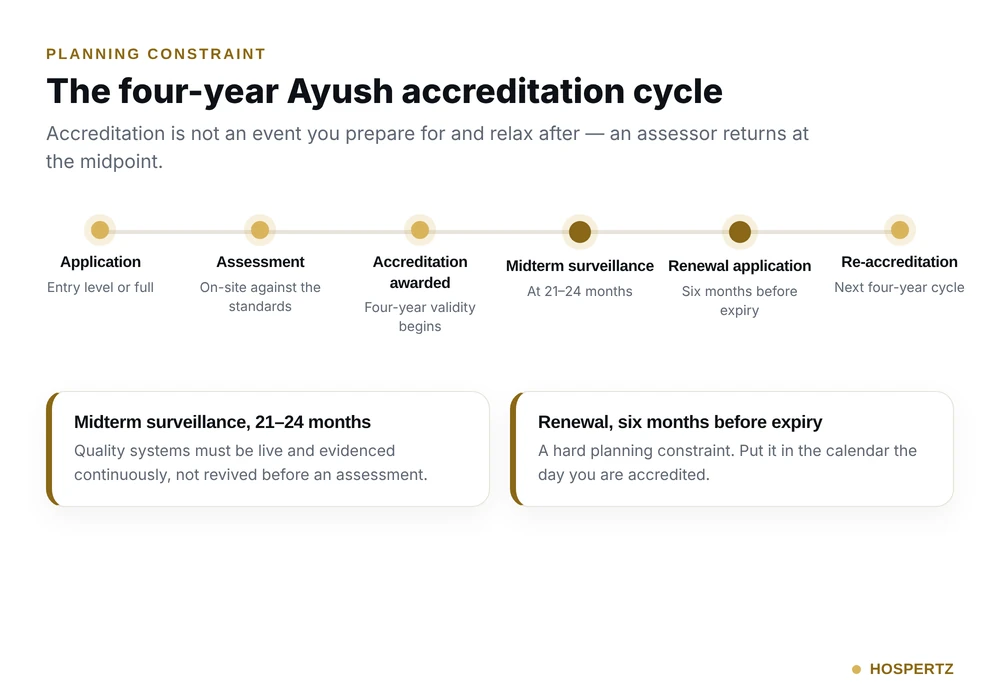
- The accreditation runs on a four-year cycle
- A midterm surveillance assessment is conducted at 21–24 months
- For renewal, an accredited Ayush hospital must apply six months before the expiry of accreditation validity
The midterm surveillance is the part that catches facilities out. Accreditation is not an event you prepare for and then relax after. Your quality systems have to be live and evidenced continuously, because an assessor is coming back roughly two years in.
The six-month renewal lead time is also a hard planning constraint. Put it in your calendar the day you are accredited.
class="attachment-full size-full wp-image-7078" alt="" srcset="https://www.hospertz.com/wp-content/uploads/2026/10/nabh-ayush-accreditation-four-year-cycle-timeline.webp 1000w, https://www.hospertz.com/wp-content/uploads/2026/10/nabh-ayush-accreditation-four-year-cycle-timeline-300x210.webp 300w, https://www.hospertz.com/wp-content/uploads/2026/10/nabh-ayush-accreditation-four-year-cycle-timeline-768x538.webp 768w, https://www.hospertz.com/wp-content/uploads/2026/10/nabh-ayush-accreditation-four-year-cycle-timeline-107x75.webp 107w, https://www.hospertz.com/wp-content/uploads/2026/10/nabh-ayush-accreditation-four-year-cycle-timeline-480x336.webp 480w, https://www.hospertz.com/wp-content/uploads/2026/10/nabh-ayush-accreditation-four-year-cycle-timeline-24x17.webp 24w, https://www.hospertz.com/wp-content/uploads/2026/10/nabh-ayush-accreditation-four-year-cycle-timeline-36x25.webp 36w, https://www.hospertz.com/wp-content/uploads/2026/10/nabh-ayush-accreditation-four-year-cycle-timeline-48x34.webp 48w" sizes="(max-width:767px) 480px, (max-width:1000px) 100vw, 1000px" /> Timeline of the NABH Ayush hospital four-year accreditation cycle with midterm surveillance
What the standards expect you to demonstrate
Two commitments sit at the foundation. The Ayush hospital commits to comply with NABH standards, and to comply with applicable legal, statutory and regulatory requirements. That second one is where many facilities have gaps, because Ayush regulation sits across multiple authorities.
Broadly, expect the framework to require evidence across these areas — confirm the exact chapter structure against the current standards document on the NABH website:
Clinical process and protocols. Documented assessment, diagnosis and treatment protocols grounded in the relevant system of medicine. Therapy plans that are recorded, reviewed and modified with documented clinical reasoning. This is where strong facilities already excel and weak ones have nothing written down.
Practitioner credentialling. Qualifications verified against the relevant statutory council registration. Scope of practice defined for each practitioner. Therapists — who deliver much of the hands-on treatment in Panchakarma settings — need documented training, competency assessment and supervision arrangements.
Medicine management. Procurement from licensed manufacturers, storage conditions appropriate to the formulation, batch and expiry tracking, and documented handling of in-house preparations. Facilities that prepare their own medicines need to evidence the licensing and quality control behind that.
Patient rights, consent and information. Informed consent for therapies, clear tariff disclosure, privacy and dignity during treatments — which has specific implications in Panchakarma and massage-based therapies — and a functioning grievance mechanism.
Infection control and hygiene. Linen handling, treatment table and equipment disinfection between patients, oil and material handling, water quality in wet treatment areas, and waste disposal including biomedical waste where applicable.
Facility management and safety. Fire safety, electrical safety, emergency preparedness and equipment maintenance. NABH’s fire safety requirements for healthcare organisations are keyed to building height and aligned with the National Building Code of India.
Quality improvement. Indicators, incident reporting, audits and demonstrated improvement over time. As with allopathic accreditation, indicator data needs history — it cannot be assembled retrospectively.
Human resources and records. Staffing adequacy, training records, and medical records that are complete, retrievable, confidential and retained for the required period.
The design dimension — where Ayush facilities most often fall short
This is the part that gets discovered too late, and it is specific to Ayush.
Ayush facilities, especially Panchakarma units, have genuinely unusual building services requirements that most architects have never encountered:
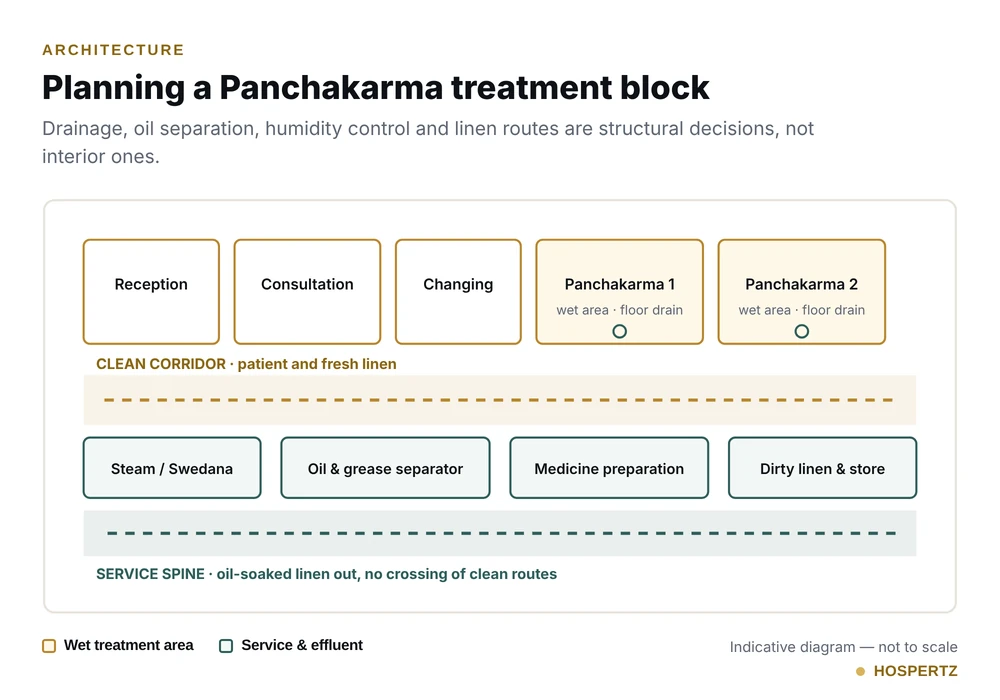
Wet treatment areas. Panchakarma involves substantial volumes of oils, decoctions and water. That means slip-resistant and chemically-resistant flooring, floor drainage designed into the slab with adequate gradient, and waterproofing that will survive daily wet use for decades. Retrofitting drainage into a finished floor means demolishing it.
Oil handling and effluent. Oil-laden effluent cannot simply enter the normal drainage line. You need grease and oil separation, and a documented disposal route that satisfies local pollution control requirements.
Ventilation and humidity. Steam therapies and wet rooms generate humidity that will destroy adjacent finishes and breed mould if ventilation is not designed for it. Mechanical extract in wet areas is not optional.
Privacy and circulation. Many therapies require substantial undressing. Treatment room layout, door positioning, changing areas and the sightlines from corridors all have to be designed for dignity — and an assessor will look at exactly this.
Linen and material logistics. Oil-soaked linen volumes are far higher than in an allopathic ward of the same size. You need a laundry route, storage capacity and a dirty-linen path that does not cross clean areas.
Medicine preparation areas. If you prepare formulations on site, those spaces need appropriate finishes, ventilation and separation.
Every one of these is cheap to design in and expensive to add later — the same pattern as allopathic NABH compliance, but with building services most project teams have no experience of. If you are planning an Ayush facility, get these requirements into the architectural brief at concept stage.
Entry-level first, or full accreditation?
For smaller facilities, the AYUSH entry-level certification route is the sensible starting point. It establishes documentation discipline, trains staff into quality habits, and produces a credential you can use commercially — all at substantially lower cost and over a shorter timeline than full accreditation.
Facilities that go straight to full accreditation without that foundation generally spend longer in preparation than those that took the staged route, because the gap between no system and a full system is larger than most owners estimate.
Confirm current fee structures and programme eligibility directly with NABH, as both are notified and revised periodically.
Hospertz tipGet floor drainage, gradient and waterproofing for Panchakarma rooms into the structural drawings, not the interior package. Drainage designed into the slab costs almost nothing extra; drainage added to a finished floor means demolishing it and re-waterproofing the level below.
class="attachment-full size-full wp-image-7079" alt="" srcset="https://www.hospertz.com/wp-content/uploads/2026/10/panchakarma-ayush-treatment-block-layout-plan.webp 1000w, https://www.hospertz.com/wp-content/uploads/2026/10/panchakarma-ayush-treatment-block-layout-plan-300x210.webp 300w, https://www.hospertz.com/wp-content/uploads/2026/10/panchakarma-ayush-treatment-block-layout-plan-768x538.webp 768w, https://www.hospertz.com/wp-content/uploads/2026/10/panchakarma-ayush-treatment-block-layout-plan-107x75.webp 107w, https://www.hospertz.com/wp-content/uploads/2026/10/panchakarma-ayush-treatment-block-layout-plan-480x336.webp 480w, https://www.hospertz.com/wp-content/uploads/2026/10/panchakarma-ayush-treatment-block-layout-plan-24x17.webp 24w, https://www.hospertz.com/wp-content/uploads/2026/10/panchakarma-ayush-treatment-block-layout-plan-36x25.webp 36w, https://www.hospertz.com/wp-content/uploads/2026/10/panchakarma-ayush-treatment-block-layout-plan-48x34.webp 48w" sizes="(max-width:767px) 480px, (max-width:1000px) 100vw, 1000px" /> Floor plan of a Panchakarma treatment block showing treatment rooms, wet areas and service routes – Note: Sanitise any real client drawing before publishing.

Our doctors, healthcare architects and NABH consultants will review your plan, budget and timeline.
Before accreditation: get the foundation right
Accreditation sits on top of statutory compliance, not instead of it. Before you begin, confirm:
- Valid clinical establishment registration under your state’s framework, with Ayush services correctly declared
- Practitioner registrations current with the relevant statutory council
- Drug licences where you store or prepare medicines
- Fire NOC appropriate to your building height
- Biomedical waste authorisation where applicable
- Local municipal and pollution control clearances, particularly for effluent
A facility that applies for accreditation with a lapsed statutory licence does not get a finding — it gets a problem with eligibility.
The commercial case
Three reasons to pursue this beyond compliance.
Insurance and panels. Accreditation is increasingly treated as a quality requirement for empanelment under government schemes, insurers and corporate health programmes. For Ayush facilities trying to move from cash-pay to insured revenue, this is the entry ticket.
Medical value travel. International patients seeking Ayurvedic treatment in India have no reliable way to assess quality. An NABH accreditation is a signal they can read, and NABH operates internationally through NABH International as well.
Pricing power. An accredited facility can defend a premium tariff. An unaccredited one competes on price with wellness resorts.
The sector is professionalising. The facilities that accredit early will define the top of the market.
Written by Dr. Vishal Jadhav, Founder & Director, Hospertz India Pvt Ltd. Last reviewed: October 2026.
Planning or upgrading an Ayush hospital or Panchakarma facility? Hospertz provides turnkey consultancy for Ayush and integrative healthcare projects across India — feasibility, architecture designed for wet-therapy and Panchakarma requirements, licensing, and NABH readiness. Get a free consultation →
Related reading: NABH accreditation process · allopathic NABH 6th edition standards · starting a clinic in India
Frequently asked questions
When did the NABH Ayush hospital standards come into effect?
The first edition of NABH’s Accreditation Standards for Ayush Hospitals came into effect on 1 April 2026. NABH has also been building the surrounding ecosystem, including an AYUSH Entry Level Certification initiative and a rationalised fee structure for that programme notified in March 2026. Confirm current implementation status on nabh.co before planning against it.
How long is Ayush hospital accreditation valid?
The accreditation runs on a four-year cycle, with a midterm surveillance assessment at 21 to 24 months. Renewal must be applied for six months before the expiry of accreditation validity — a hard planning constraint worth entering in the calendar the day you are accredited.
Should a small Panchakarma centre go for entry level or full accreditation?
For smaller facilities, the AYUSH entry-level certification route is usually the sensible start. It establishes documentation discipline, trains staff into quality habits and produces a credential you can use commercially, at lower cost and over a shorter timeline. Facilities that jump straight to full accreditation generally spend longer in preparation than those that staged it.
What design requirements are specific to Ayush and Panchakarma facilities?
Slip-resistant and chemically-resistant flooring with drainage designed into the slab, grease and oil separation before effluent enters the drainage line, mechanical extract for steam and wet rooms, treatment room layouts and sightlines designed for dignity during therapy, high-volume oil-soaked linen routes that do not cross clean areas, and appropriately finished medicine preparation areas where formulations are made on site.
What statutory licences are needed before applying for Ayush accreditation?
Valid clinical establishment registration under your state’s framework with Ayush services correctly declared, current practitioner registrations with the relevant statutory council, drug licences where you store or prepare medicines, a fire NOC appropriate to your building height, biomedical waste authorisation where applicable, and local municipal and pollution control clearances — particularly for effluent.
class="attachment-full size-full wp-image-7068" alt="" srcset="https://www.hospertz.com/wp-content/uploads/2026/10/vishal-Jadhav-15.png 500w, https://www.hospertz.com/wp-content/uploads/2026/10/vishal-Jadhav-15-300x300.png 300w, https://www.hospertz.com/wp-content/uploads/2026/10/vishal-Jadhav-15-150x150.png 150w, https://www.hospertz.com/wp-content/uploads/2026/10/vishal-Jadhav-15-75x75.png 75w, https://www.hospertz.com/wp-content/uploads/2026/10/vishal-Jadhav-15-480x480.png 480w, https://www.hospertz.com/wp-content/uploads/2026/10/vishal-Jadhav-15-24x24.png 24w, https://www.hospertz.com/wp-content/uploads/2026/10/vishal-Jadhav-15-36x36.png 36w, https://www.hospertz.com/wp-content/uploads/2026/10/vishal-Jadhav-15-48x48.png 48w" sizes="(max-width:767px) 480px, 500px" /> Founder and Director of Hospertz. After a career in medicine, Dr. Vishal moved into corporate healthcare and now leads a team of healthcare architects, NABH consultants and project managers who plan and build hospitals, clinics and diagnostic centres across India.
Related guides
Turn this guide into a plan for your hospital.
Get a free first consultation on feasibility, licences, budget and timelines from the Hospertz team in Mumbai, Bhopal or Chhattisgarh.