
Tier-2 & Tier-3 Hospital Investment in India: The 2026 Case
October 19, 202650 vs 100 vs 200 Beds: Which Hospital Size Should You Build?
October 21, 2026NABH 6th Edition: The Full Requirements Checklist for 2026

NABH 6th Edition: The Complete Requirements Checklist for Hospitals
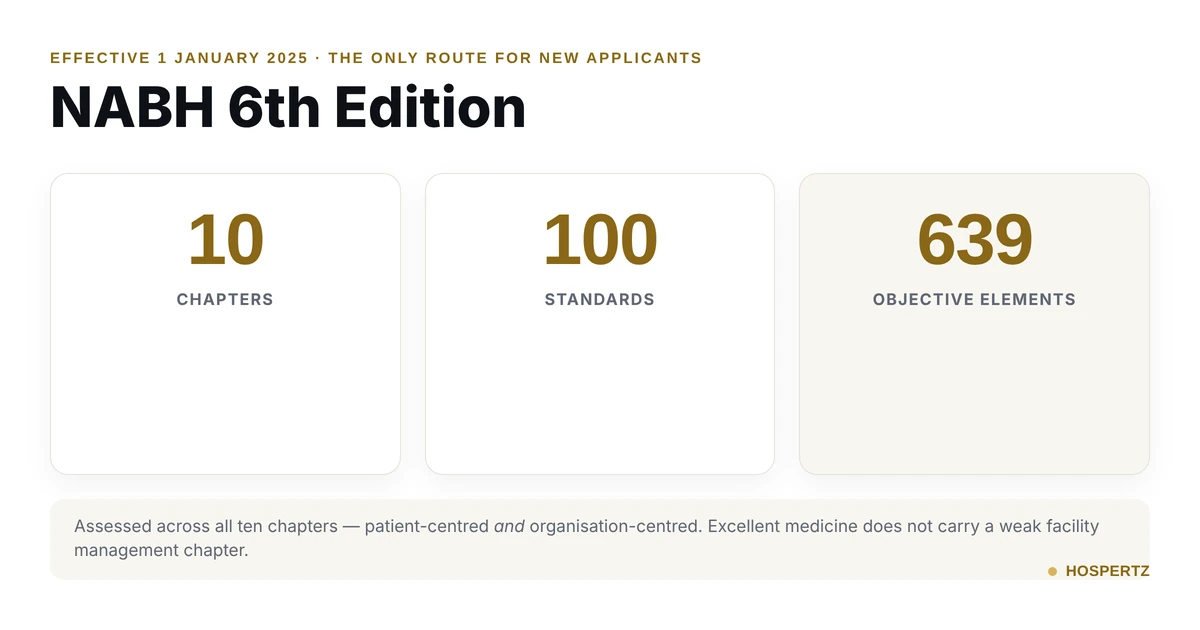
The NABH 6th edition took effect on 1 January 2025 and is the only framework open to new applicants: 100 standards and 639 objective elements across ten chapters. This is a chapter-by-chapter view of what it asks for, what changed most from the 5th edition, and where hospitals consistently come up short.
class="attachment-full size-full wp-image-7020" alt="" srcset="https://www.hospertz.com/wp-content/uploads/2026/10/vishal-Jadhav-10.png 500w, https://www.hospertz.com/wp-content/uploads/2026/10/vishal-Jadhav-10-300x300.png 300w, https://www.hospertz.com/wp-content/uploads/2026/10/vishal-Jadhav-10-150x150.png 150w, https://www.hospertz.com/wp-content/uploads/2026/10/vishal-Jadhav-10-75x75.png 75w, https://www.hospertz.com/wp-content/uploads/2026/10/vishal-Jadhav-10-480x480.png 480w, https://www.hospertz.com/wp-content/uploads/2026/10/vishal-Jadhav-10-24x24.png 24w, https://www.hospertz.com/wp-content/uploads/2026/10/vishal-Jadhav-10-36x36.png 36w, https://www.hospertz.com/wp-content/uploads/2026/10/vishal-Jadhav-10-48x48.png 48w" sizes="(max-width:767px) 480px, 500px" /> Dr. Vishal Jadhav · Founder, Hospertz
16 October 2026 6 min read
class="attachment-full size-full wp-image-7032" alt="" srcset="https://www.hospertz.com/wp-content/uploads/2026/10/nabh-6th-edition-standards-chapters-objective-elements.webp 1200w, https://www.hospertz.com/wp-content/uploads/2026/10/nabh-6th-edition-standards-chapters-objective-elements-300x158.webp 300w, https://www.hospertz.com/wp-content/uploads/2026/10/nabh-6th-edition-standards-chapters-objective-elements-1024x538.webp 1024w, https://www.hospertz.com/wp-content/uploads/2026/10/nabh-6th-edition-standards-chapters-objective-elements-768x403.webp 768w, https://www.hospertz.com/wp-content/uploads/2026/10/nabh-6th-edition-standards-chapters-objective-elements-143x75.webp 143w, https://www.hospertz.com/wp-content/uploads/2026/10/nabh-6th-edition-standards-chapters-objective-elements-480x252.webp 480w, https://www.hospertz.com/wp-content/uploads/2026/10/nabh-6th-edition-standards-chapters-objective-elements-24x13.webp 24w, https://www.hospertz.com/wp-content/uploads/2026/10/nabh-6th-edition-standards-chapters-objective-elements-36x19.webp 36w, https://www.hospertz.com/wp-content/uploads/2026/10/nabh-6th-edition-standards-chapters-objective-elements-48x25.webp 48w" sizes="(max-width:767px) 480px, (max-width:1200px) 100vw, 1200px" /> In this article
- 639 objective elements across ten chapters, and most of them need evidence that accumulates over time rather than evidence assembled before an assessment.
- Five areas changed most: digital health and HIS/EMR, antimicrobial stewardship, quality indicators, ADR reporting linked to PvPI, and patient safety and infection control.
- Indicator data cannot be created retrospectively — this is the single most time-critical item in the whole framework.
- Built-environment requirements are the only ones with a hard deadline, because concrete does not move.
- Clinically excellent hospitals fail on documentation discipline and facility evidence far more often than on medicine.
The 6th edition of the NABH hospital accreditation standards took effect on 1 January 2025 and is the only framework available to new applicants. The 5th edition pathway is closed. Any hospital preparing for first-time accreditation, or renewing into the current cycle, is being assessed against 100 standards and 639 objective elements across ten chapters.
That number — 639 — is the one to sit with. It is not a documentation exercise. It is 639 specific things an assessor can ask you to demonstrate, and most of them require evidence that accumulates over time rather than evidence you can assemble in the fortnight before an assessment.
This is a chapter-by-chapter view of what the 6th edition actually asks for, and where hospitals consistently come up short.
How the standards are organised
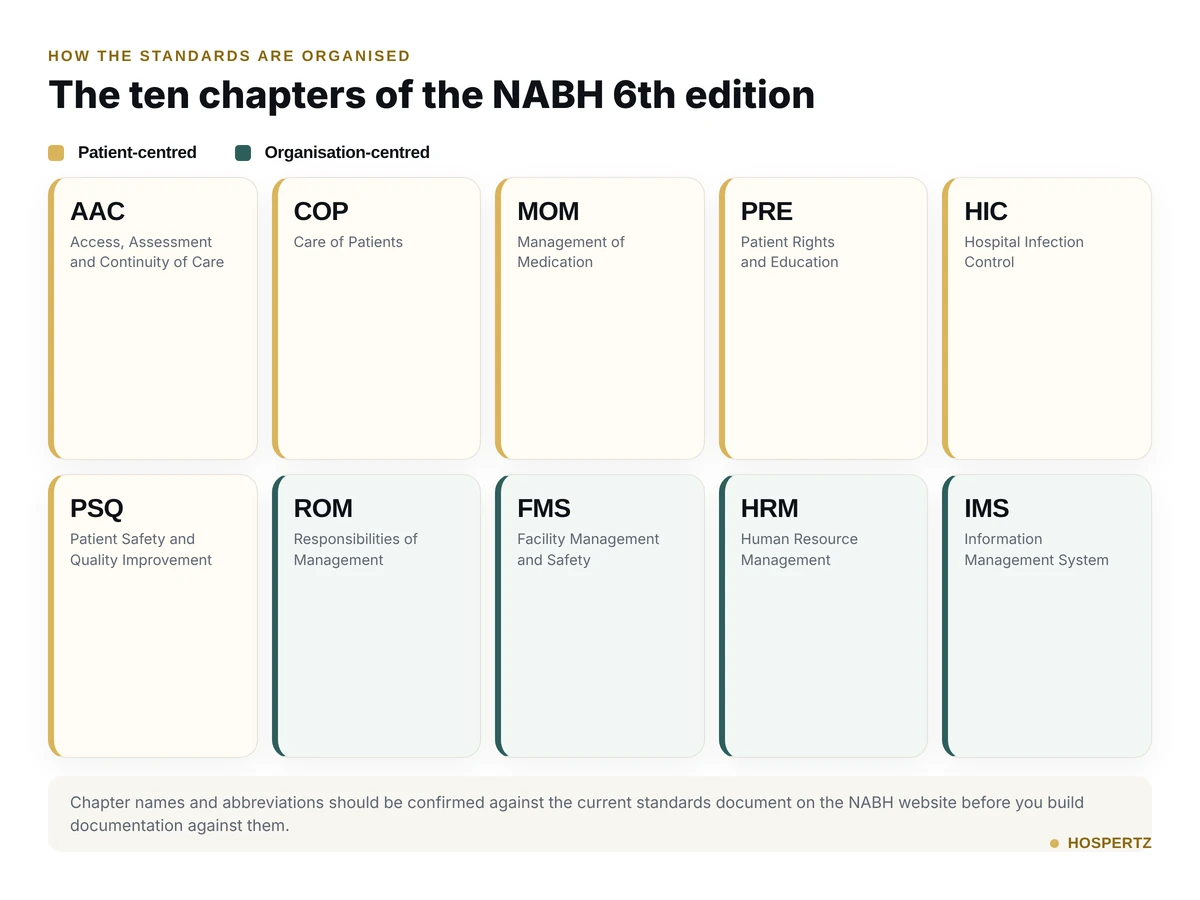
NABH structures its standards into patient-centred chapters and organisation-centred chapters. Hospitals are assessed across all of them, which is the first thing that surprises clinically strong hospitals: excellent medicine does not carry a weak facility management chapter.
| # | Chapter | Focus |
|---|---|---|
| 1 | AAC — Access, Assessment and Continuity of Care | Registration, assessment, transfer, discharge, continuity |
| 2 | COP — Care of Patients | Clinical protocols, high-risk care, critical areas, anaesthesia, surgery |
| 3 | MOM — Management of Medication | Procurement, storage, prescribing, administration, ADR reporting |
| 4 | PRE — Patient Rights and Education | Consent, information, privacy, grievance redressal, tariff transparency |
| 5 | HIC — Hospital Infection Control | Surveillance, antimicrobial stewardship, sterilisation, waste |
| 6 | PSQ — Patient Safety and Quality Improvement | Indicators, incident reporting, audits, continuous improvement |
| 7 | ROM — Responsibilities of Management | Governance, licences, ethics, risk management |
| 8 | FMS — Facility Management and Safety | Built environment, fire, utilities, equipment, hazardous materials |
| 9 | HRM — Human Resource Management | Credentialling, privileging, training, appraisal, staff wellbeing |
| 10 | IMS — Information Management System | Records, retention, confidentiality, digital health |
Chapter names and abbreviations should be confirmed against the current standards document on the NABH website before you build documentation against them.
What changed most from the 5th edition
Five areas received materially more attention, and they are where most gaps are found.
1. Digital health and HIS/EMR
This is the headline change. NABH placed strong emphasis on how hospitals integrate digital health solutions into operations — including adoption of digital health technologies to improve clinical protocols and patient management.
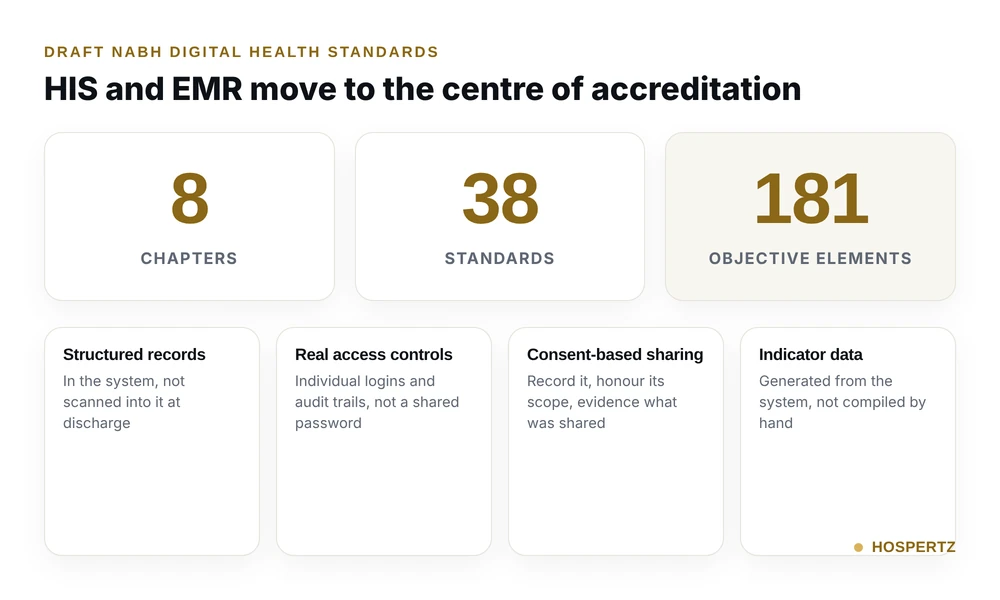
NABH has gone further and issued draft Digital Health Standards for hospitals, with complementary standards for Hospital Information System and Electronic Medical Record systems — a framework of 8 chapters, 38 standards and 181 objective elements. These sit alongside the hospital standards and signal where assessment is heading.
What this means in practice: a hospital with an HIS that the clinical staff route around is now a finding, not a quirk. Assessors look at whether the system is used, whether records are complete within it, whether access controls are real, and whether the data in it supports the indicators you report.
2. Antimicrobial stewardship
The 6th edition introduced new requirements for antimicrobial stewardship. A policy document is not sufficient. Expect to evidence a functioning stewardship programme: an antibiotic policy linked to local sensitivity patterns, restricted-antibiotic authorisation, prescription audit, and consumption data trended over time.
Hospitals without a microbiologist or a clinical pharmacist find this chapter the hardest. Plan the resourcing, not just the document.
3. Quality indicators
The 6th edition expanded the quality indicator requirements, with around 15 new indicators and an expectation of benchmarking against national standards.
This is the most time-critical item in the entire framework, for a simple reason: indicator data cannot be created retrospectively. An assessor wants a trend, a discussion of the trend at a quality committee, and an action taken where the trend was adverse. A hospital that starts collecting indicators two months before assessment has nothing meaningful to show. Start now, even imperfectly.
4. Adverse drug reaction reporting
A functioning ADR reporting system linked to the Pharmacovigilance Programme of India (PvPI) is now assessed. Registration with the relevant PvPI centre, a reporting pathway staff actually know, and a record of reports submitted — all three are needed.
5. Patient safety, infection control and waste
Enhanced protocols for patient safety including improved infection control measures and medical waste management, alongside a heightened focus on patient rights and involvement in care decisions.
Palliative care consent protocols are assessed for hospitals with oncology and ICU departments — worth noting for anyone planning an oncology facility.
class="attachment-full size-full wp-image-7033" alt="" srcset="https://www.hospertz.com/wp-content/uploads/2026/10/nabh-6th-edition-ten-chapters-structure-diagram.webp 1200w, https://www.hospertz.com/wp-content/uploads/2026/10/nabh-6th-edition-ten-chapters-structure-diagram-300x225.webp 300w, https://www.hospertz.com/wp-content/uploads/2026/10/nabh-6th-edition-ten-chapters-structure-diagram-1024x768.webp 1024w, https://www.hospertz.com/wp-content/uploads/2026/10/nabh-6th-edition-ten-chapters-structure-diagram-768x576.webp 768w, https://www.hospertz.com/wp-content/uploads/2026/10/nabh-6th-edition-ten-chapters-structure-diagram-100x75.webp 100w, https://www.hospertz.com/wp-content/uploads/2026/10/nabh-6th-edition-ten-chapters-structure-diagram-960x720.webp 960w, https://www.hospertz.com/wp-content/uploads/2026/10/nabh-6th-edition-ten-chapters-structure-diagram-480x360.webp 480w, https://www.hospertz.com/wp-content/uploads/2026/10/nabh-6th-edition-ten-chapters-structure-diagram-24x18.webp 24w, https://www.hospertz.com/wp-content/uploads/2026/10/nabh-6th-edition-ten-chapters-structure-diagram-36x27.webp 36w, https://www.hospertz.com/wp-content/uploads/2026/10/nabh-6th-edition-ten-chapters-structure-diagram-48x36.webp 48w" sizes="(max-width:767px) 480px, (max-width:1200px) 100vw, 1200px" /> Diagram of the ten chapters in the NABH 6th edition hospital accreditation standards
The built environment: what you cannot fix later
This is the section most hospital owners read too late, and it is the one that costs the most money.
Facility management and safety requirements interact directly with architecture. NABH has notified fire safety requirements for healthcare organisations aligned with the National Building Code of India, with requirements that differ according to building height — distinct bands for buildings below 9 metres or ground-plus-one, 9 to 15 metres, 15 metres and above, and above 24 metres.
The practical consequence: your building height is an accreditation decision, not just a planning decision. Crossing a height threshold changes your fire safety obligations permanently.
The items that are cheap on a drawing and brutally expensive after commissioning:
- Corridor and door widths for trolley and bed movement
- Isolation room pressure differentials and air changes — requires ducting and plant capacity designed in
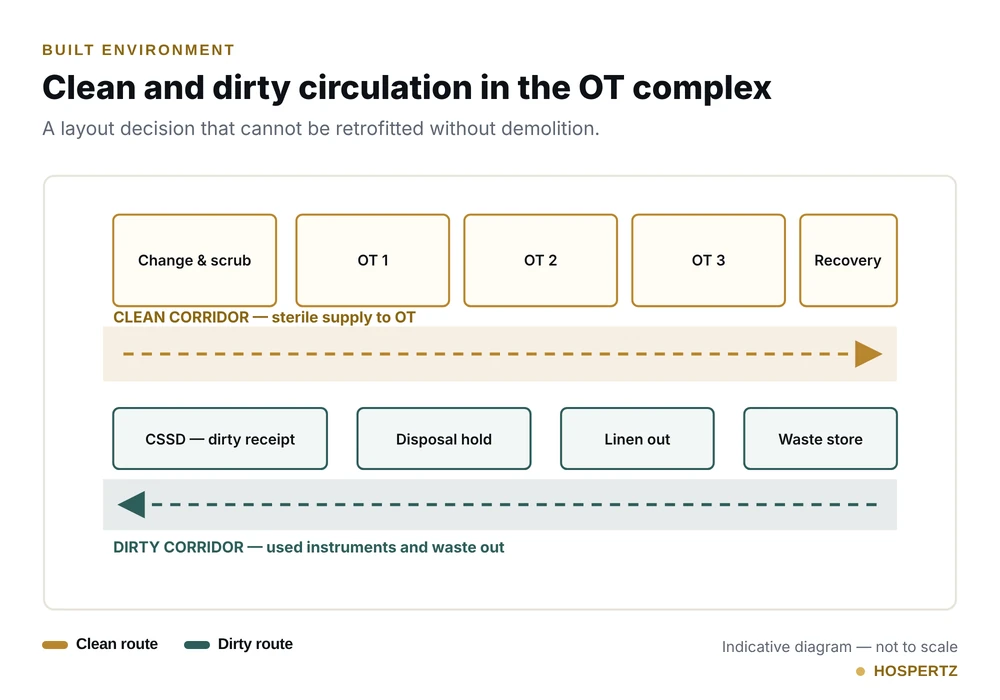
- Separation of clean and dirty circulation in the OT complex and CSSD — a layout decision that cannot be retrofitted without demolition
- Fire compartmentation, exit widths and refuge areas per NBC
- Biomedical waste segregation, storage and transit routes that do not cross clean areas
- Medical gas pipeline layout, manifold room siting and alarm points
- Ramp gradients and lift sizes for stretcher access
Every one of these is a line item in a design brief and a demolition contract afterwards. This is the single strongest argument for bringing NABH requirements into the architectural stage — which is why we treat it as a design input rather than a post-construction compliance review.
class="attachment-full size-full wp-image-7034" alt="" srcset="https://www.hospertz.com/wp-content/uploads/2026/10/ot-complex-clean-dirty-circulation-nabh-design.webp 1000w, https://www.hospertz.com/wp-content/uploads/2026/10/ot-complex-clean-dirty-circulation-nabh-design-300x210.webp 300w, https://www.hospertz.com/wp-content/uploads/2026/10/ot-complex-clean-dirty-circulation-nabh-design-768x538.webp 768w, https://www.hospertz.com/wp-content/uploads/2026/10/ot-complex-clean-dirty-circulation-nabh-design-107x75.webp 107w, https://www.hospertz.com/wp-content/uploads/2026/10/ot-complex-clean-dirty-circulation-nabh-design-480x336.webp 480w, https://www.hospertz.com/wp-content/uploads/2026/10/ot-complex-clean-dirty-circulation-nabh-design-24x17.webp 24w, https://www.hospertz.com/wp-content/uploads/2026/10/ot-complex-clean-dirty-circulation-nabh-design-36x25.webp 36w, https://www.hospertz.com/wp-content/uploads/2026/10/ot-complex-clean-dirty-circulation-nabh-design-48x34.webp 48w" sizes="(max-width:767px) 480px, (max-width:1000px) 100vw, 1000px" /> Operation theatre complex layout showing separated clean and dirty circulation routes for NABH compliance – Note: Use a sanitised extract from your own AutoCAD drawings — remove client names, dimensions you consider proprietary, and your title block details if needed.
A practical preparation sequence
Months 1–2: Gap assessment. Assess against all ten chapters. Score each objective element as compliant, partially compliant or non-compliant, with the evidence that would be shown. Be harsh — a generous self-assessment is worthless.
Month 2: Start indicator data collection. Before documentation, before SOPs. Every month of history is an asset.
Months 2–5: Documentation and SOPs. Build from your gap assessment, not from a downloaded template. E-Mitra provides frameworks hospitals can adapt, but NABH is explicit that downloading and implementing documents does not guarantee accreditation — the documents must reflect what your hospital actually does.
Months 4–8: Implementation and training. This is the longest phase and the one that is routinely underestimated. Committees must meet and minute their meetings. Staff must know the protocols. Drills must happen. Audits must be conducted and closed out.
Months 8–10: Internal audit and mock assessment. Run a full mock against all 639 elements, ideally with someone who has not been involved in building the system.
Months 10–12: Application and assessment. The accreditation cycle runs with a midterm surveillance assessment, so readiness has to be sustainable rather than a one-off push.
Timelines vary considerably with hospital size, existing maturity and resourcing. Smaller hospitals with good existing discipline move faster; large hospitals with legacy practices take longer.
class="attachment-full size-full wp-image-7035" alt="" srcset="https://www.hospertz.com/wp-content/uploads/2026/10/nabh-digital-health-standards-his-emr-hospital.webp 1000w, https://www.hospertz.com/wp-content/uploads/2026/10/nabh-digital-health-standards-his-emr-hospital-300x180.webp 300w, https://www.hospertz.com/wp-content/uploads/2026/10/nabh-digital-health-standards-his-emr-hospital-768x461.webp 768w, https://www.hospertz.com/wp-content/uploads/2026/10/nabh-digital-health-standards-his-emr-hospital-125x75.webp 125w, https://www.hospertz.com/wp-content/uploads/2026/10/nabh-digital-health-standards-his-emr-hospital-480x288.webp 480w, https://www.hospertz.com/wp-content/uploads/2026/10/nabh-digital-health-standards-his-emr-hospital-24x14.webp 24w, https://www.hospertz.com/wp-content/uploads/2026/10/nabh-digital-health-standards-his-emr-hospital-36x22.webp 36w, https://www.hospertz.com/wp-content/uploads/2026/10/nabh-digital-health-standards-his-emr-hospital-48x29.webp 48w" sizes="(max-width:767px) 480px, (max-width:1000px) 100vw, 1000px" /> Hospital information system supporting NABH digital health standards requirements

Where hospitals most often fail
From assessment patterns, the recurring gaps are consistent:
- Indicator data with no history — the most common single failure
- Committees that exist on paper but have no minutes, no attendance and no closed actions
- Credentialling and privileging files incomplete for visiting consultants
- Facility management evidence — equipment maintenance schedules, calibration records and utility testing logs not maintained
- Staff who do not know the protocol that the manual says they follow
- Antimicrobial stewardship as a policy with no programme behind it
- Fire drill and emergency preparedness records missing or not recent
Note how few of these are clinical. Clinically excellent hospitals fail on documentation discipline and facility evidence far more often than on medicine.
Hospertz tipScore your gap assessment harshly and have someone outside the quality team do the scoring. A generous self-assessment is worse than none, because it consumes the months you had available and leaves the same gaps in place on assessment day.
Our doctors, healthcare architects and NABH consultants will review your plan, budget and timeline.
If you are above 300 beds
Programme eligibility changed in October 2026 — hospitals above 300 sanctioned beds face restrictions on the HOPE route. See the October 2026 HOPE change for what that means for pathway selection.
Start where it is cheapest
If you are building a hospital: bring the 6th edition into your architectural brief now. The built-environment requirements are the only ones with a hard deadline, because concrete does not move.
If you are running a hospital: start indicator data collection this month. Everything else can be compressed. That cannot.
For the application and assessment mechanics, see our NABH accreditation process guide, and for the statutory foundation underneath it, licences required to open a hospital.
Written by Dr. Vishal Jadhav, Founder & Director, Hospertz India Pvt Ltd, with input from the Hospertz NABH consultancy team. Last reviewed: October 2026.
Preparing for NABH 6th edition assessment? Hospertz provides NABH readiness support — gap assessment against all ten chapters, documentation and SOP development, staff training and mock assessments — alongside NABH-compliant architectural design for projects under construction. Get a free consultation →
Frequently asked questions
How many standards and objective elements are in the NABH 6th edition?
The 6th edition contains 100 standards and 639 objective elements across ten chapters, covering both patient-centred and organisation-centred areas. Hospitals are assessed across all ten chapters, which is why clinically strong hospitals can still fail on facility management or quality improvement.
Can a hospital still apply under the 5th edition?
No. The 6th edition took effect on 1 January 2025 and the 5th edition pathway is closed to new applicants. Any hospital preparing for first-time accreditation, or renewing into the current cycle, is assessed against the 6th edition.
How long does NABH 6th edition preparation take?
A realistic sequence runs roughly twelve months: gap assessment in months 1–2, indicator data collection starting in month 2, documentation and SOPs through months 2–5, implementation and training through months 4–8, internal audit and mock assessment at months 8–10, then application and assessment. Timelines vary considerably with hospital size, existing maturity and resourcing.
Why do hospitals most often fail an NABH assessment?
Indicator data with no history is the most common single failure. After that: committees that exist on paper with no minutes or closed actions, incomplete credentialling files for visiting consultants, missing equipment maintenance and calibration records, staff who do not know the protocol the manual says they follow, and antimicrobial stewardship as a policy with no programme behind it.
Can we use downloaded NABH documentation templates?
E-Mitra provides frameworks hospitals can adapt, but NABH is explicit that downloading and implementing documents does not guarantee accreditation. The documents have to reflect what your hospital actually does, because assessors evaluate practice rather than paperwork — a manual describing a process nobody follows is itself a finding.
class="attachment-full size-full wp-image-7021" alt="" srcset="https://www.hospertz.com/wp-content/uploads/2026/10/vishal-Jadhav-11.png 500w, https://www.hospertz.com/wp-content/uploads/2026/10/vishal-Jadhav-11-300x300.png 300w, https://www.hospertz.com/wp-content/uploads/2026/10/vishal-Jadhav-11-150x150.png 150w, https://www.hospertz.com/wp-content/uploads/2026/10/vishal-Jadhav-11-75x75.png 75w, https://www.hospertz.com/wp-content/uploads/2026/10/vishal-Jadhav-11-480x480.png 480w, https://www.hospertz.com/wp-content/uploads/2026/10/vishal-Jadhav-11-24x24.png 24w, https://www.hospertz.com/wp-content/uploads/2026/10/vishal-Jadhav-11-36x36.png 36w, https://www.hospertz.com/wp-content/uploads/2026/10/vishal-Jadhav-11-48x48.png 48w" sizes="(max-width:767px) 480px, 500px" /> Founder and Director of Hospertz. After a career in medicine, Dr. Vishal moved into corporate healthcare and now leads a team of healthcare architects, NABH consultants and project managers who plan and build hospitals, clinics and diagnostic centres across India.
Related guides
Turn this guide into a plan for your hospital.
Get a free first consultation on feasibility, licences, budget and timelines from the Hospertz team in Mumbai, Bhopal or Chhattisgarh.