

Clinical Establishments Act Registration in India: A Complete Guide for Hospitals & Clinics
July 18, 2026PMJAY De-Empanelment: How to Protect Your Hospital in 2026
October 17, 2026NABH HOPE Rule Change 2026: What 300+ Bed Hospitals Must Do

NABH HOPE Rule Change 2026: What Hospitals Above 300 Beds Must Do Now
From 1 October 2026, hospitals with more than 300 sanctioned beds can no longer enter or renew NABH accreditation through the HOPE route. This guide explains what notification NABH/Gen/2025/3798 changed, which NABH programme now applies at your bed strength, and the five things a large hospital should do this quarter.
class="attachment-full size-full wp-image-6843" alt="" srcset="https://www.hospertz.com/wp-content/uploads/2026/10/vishal-Jadhav-4.png 500w, https://www.hospertz.com/wp-content/uploads/2026/10/vishal-Jadhav-4-300x300.png 300w, https://www.hospertz.com/wp-content/uploads/2026/10/vishal-Jadhav-4-150x150.png 150w, https://www.hospertz.com/wp-content/uploads/2026/10/vishal-Jadhav-4-75x75.png 75w, https://www.hospertz.com/wp-content/uploads/2026/10/vishal-Jadhav-4-480x480.png 480w, https://www.hospertz.com/wp-content/uploads/2026/10/vishal-Jadhav-4-24x24.png 24w, https://www.hospertz.com/wp-content/uploads/2026/10/vishal-Jadhav-4-36x36.png 36w, https://www.hospertz.com/wp-content/uploads/2026/10/vishal-Jadhav-4-48x48.png 48w" sizes="(max-width:767px) 480px, 500px" /> Dr. Vishal Jadhav · Founder, Hospertz
16 October 2026 6 min read
In this article
- Hospitals above 300 sanctioned beds generally cannot submit new or renewal HOPE applications from 1 October 2026, under notification NABH/Gen/2025/3798 of 21 April 2025.
- Two exceptions apply: government-owned hospitals of any size, and above-300-bed hospitals newly commissioned on or after 1 October 2026 (one cycle).
- For most hospitals with more than 300 sanctioned beds, the standard pathway is NABH Hospital Accreditation (HCO) under the applicable accreditation standards. However, NABH’s notification provides exceptions for government-owned hospitals and newly commissioned hospitals from 1 October 2026, which may qualify for one cycle of HOPE Entry Level Certification, subject to the applicable conditions.
- Eligibility runs on sanctioned beds, not commissioned or occupied beds. Confirm the figure in writing before choosing a pathway.
- Quality indicator data cannot be created retrospectively — start collecting this quarter, whatever else you delay.
- Accreditation now sits underneath TPA, PMJAY, CGHS and corporate empanelment, so a lapsed pathway is a revenue risk, not a paperwork risk.
If your hospital has more than 300 sanctioned beds and you were planning to apply — or re-apply — through the NABH HOPE route, that door has closed.
Under NABH notification NABH/Gen/2025/3798, issued on 21 April 2025, hospitals with more than 300 sanctioned beds generally cannot submit new or renewal HOPE applications from 1 October 2026. For large hospitals that had been using HOPE as a lighter-touch entry into the NABH ecosystem, this is a significant change in how accreditation has to be planned, budgeted and resourced.
Here is what actually changed, who it affects, and what to do about it.
What the change says
NABH runs several parallel programmes rather than one single accreditation. HOPE — the entry-level route operated in association with the Quality Council of India — has historically been the lowest rung on the quality ladder, designed to bring facilities into a structured quality framework before they attempt full accreditation.
The notification restricts that route by size. Issued on 21 April 2025 and taking effect on 1 October 2026, it provides that hospitals with more than 300 beds are to transition to the Hospital Accreditation Programme, and that no fresh or renewal applications under the HOPE Entry Level Certification Programme will be accepted from them after that date. The logic is reasonable: a 400-bed multispeciality hospital operating on an entry-level framework creates a mismatch between the complexity of care being delivered and the depth of the quality system being assessed.
Two exceptions are written into the notification. Government-owned hospitals remain eligible for HOPE regardless of their size or date of commissioning. And a hospital above 300 beds that is newly commissioned on or after 1 October 2026 may still take HOPE certification for one certification cycle. If neither applies to you, the restriction does.
The practical effect is that larger private hospitals already in operation must now engage with the full accreditation framework — and that framework is the 6th edition.
Why this matters more than it looks
Three consequences follow, and the third is the one that catches people out.
First, the bar is genuinely higher. The 6th edition of the NABH hospital standards took effect on 1 January 2025 and contains 100 standards and 639 objective elements across ten chapters. Every new accreditation application is assessed against it; the 5th edition pathway is closed to new applicants. If your quality documentation was built for an entry-level framework, it will not survive a 6th edition assessment without substantial rework.
Second, the preparation timeline is longer. Entry-level readiness can sometimes be achieved in a few months. Full 6th edition readiness realistically takes considerably longer, because it requires not just documentation but demonstrated practice — audited data, functioning committees, trained staff and evidence of continuous quality improvement over time. Assessors evaluate what the hospital actually does, not what its manual says it does.
Third — and this is the expensive one — accreditation status is increasingly load-bearing for revenue. NABH accreditation is now widely treated as a quality requirement for empanelment under government healthcare schemes, insurance providers and corporate health programmes. If a renewal lapses because the hospital planned for the wrong pathway and ran out of runway, the knock-on effect is not just a certificate — it is potential disruption to hospital empanelment and cashless insurance arrangements that your occupancy depends on.
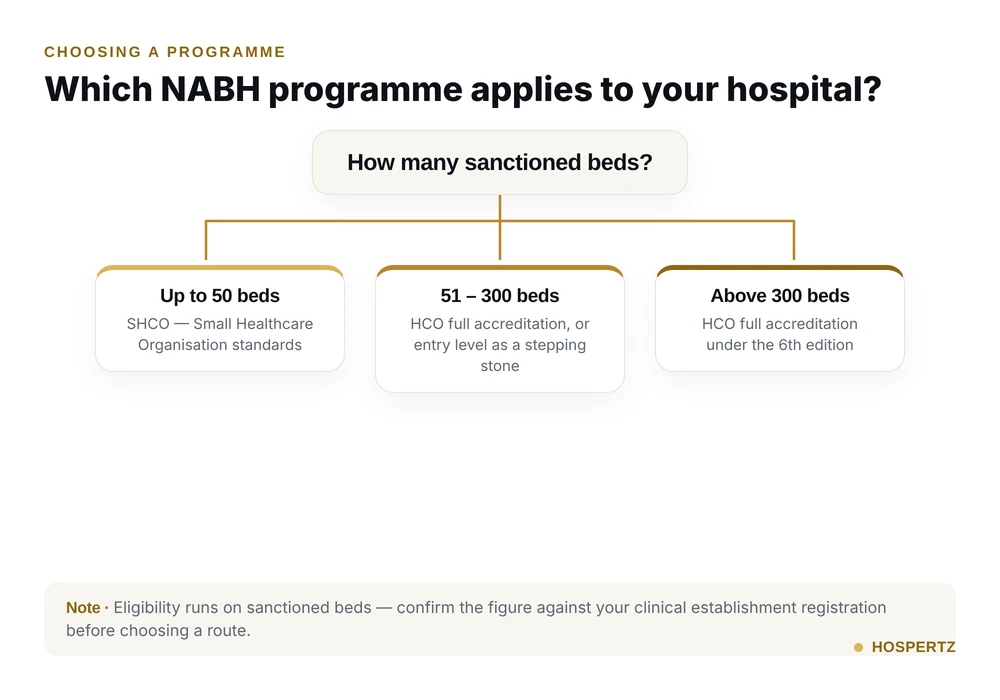
class="attachment-full size-full wp-image-6845" alt="" srcset="https://www.hospertz.com/wp-content/uploads/2026/10/nabh-programme-selection-flowchart-by-bed-count-1.webp 1000w, https://www.hospertz.com/wp-content/uploads/2026/10/nabh-programme-selection-flowchart-by-bed-count-1-300x210.webp 300w, https://www.hospertz.com/wp-content/uploads/2026/10/nabh-programme-selection-flowchart-by-bed-count-1-768x538.webp 768w, https://www.hospertz.com/wp-content/uploads/2026/10/nabh-programme-selection-flowchart-by-bed-count-1-107x75.webp 107w, https://www.hospertz.com/wp-content/uploads/2026/10/nabh-programme-selection-flowchart-by-bed-count-1-480x336.webp 480w, https://www.hospertz.com/wp-content/uploads/2026/10/nabh-programme-selection-flowchart-by-bed-count-1-24x17.webp 24w, https://www.hospertz.com/wp-content/uploads/2026/10/nabh-programme-selection-flowchart-by-bed-count-1-36x25.webp 36w, https://www.hospertz.com/wp-content/uploads/2026/10/nabh-programme-selection-flowchart-by-bed-count-1-48x34.webp 48w" sizes="(max-width:767px) 480px, (max-width:1000px) 100vw, 1000px" /> Flowchart showing which NABH programme a hospital should choose based on sanctioned bed strength
Which NABH programme should your hospital choose?
Programme eligibility is driven largely by sanctioned bed strength and facility type.
Up to 50 beds — SHCO. The Small Healthcare Organisation standards are designed for nursing homes and smaller hospitals, with requirements proportionate to scale.
51 to 300 beds — HCO (full accreditation), or the entry-level certification route as a stepping stone. Many hospitals in this band deliberately take entry-level certification first to build quality discipline, then progress to full accreditation within two to three years. That remains a legitimate and sensible strategy.
Above 300 beds — HCO full accreditation under the 6th edition. For private hospitals already in operation this is now effectively the only route, following the change that took effect on 1 October 2026. Government-owned hospitals are exempt from that restriction.
A caution on bed counts: eligibility runs on sanctioned beds, not occupied beds or beds currently in service. Hospitals that have sanctioned capacity for future phases but commissioned only part of it have been caught out by this distinction. If your project is phased — as most greenfield hospitals are — confirm your sanctioned figure before selecting a programme.
If you are above 300 beds, do these five things
- Confirm your sanctioned bed strength in writing. Pull the figure from your clinical establishment registration and your approved building plans. Do not rely on an internal number.
- Run a 6th edition gap assessment. Assess against all ten chapters, not just the clinical ones. In our experience the chapters hospitals consistently under-prepare are facility management and safety, and continuous quality improvement — because both require historical data that cannot be created retrospectively.
- Start collecting quality indicator data now. The 6th edition expanded the quality indicator requirements significantly. Indicators need a data history before an assessment, so every month you delay is a month of baseline you cannot recover. This is the single most common reason a hospital is technically ready but assessment-unready.
- Check the chapters that changed most. Digital health integration, antimicrobial stewardship, and adverse drug reaction reporting linked to the Pharmacovigilance Programme of India all receive materially more attention in the 6th edition than they did previously. If your hospital has an HIS that nobody fully uses, or an infection control committee that meets irregularly, those are now assessable gaps.
- Map accreditation against your empanelment renewal calendar. Work backwards from the dates that actually cost you money — TPA contracts, PMJAY empanelment, CGHS and ECHS, corporate panels — and make sure your accreditation timeline sits comfortably inside them, not up against them.
Hospertz tipBefore you commission a pathway decision, pull the sanctioned bed figure from three places — your clinical establishment registration, your sanctioned building plan and your last empanelment application — and check they agree. Where they disagree, the licensing authority’s figure is the one an assessor will use, and reconciling it afterwards costs weeks.
A note for hospitals still under construction
If you are building a hospital now and expect to cross 300 beds, design for the 6th edition from the start. It is dramatically cheaper to build NABH-compliant infrastructure than to retrofit it.
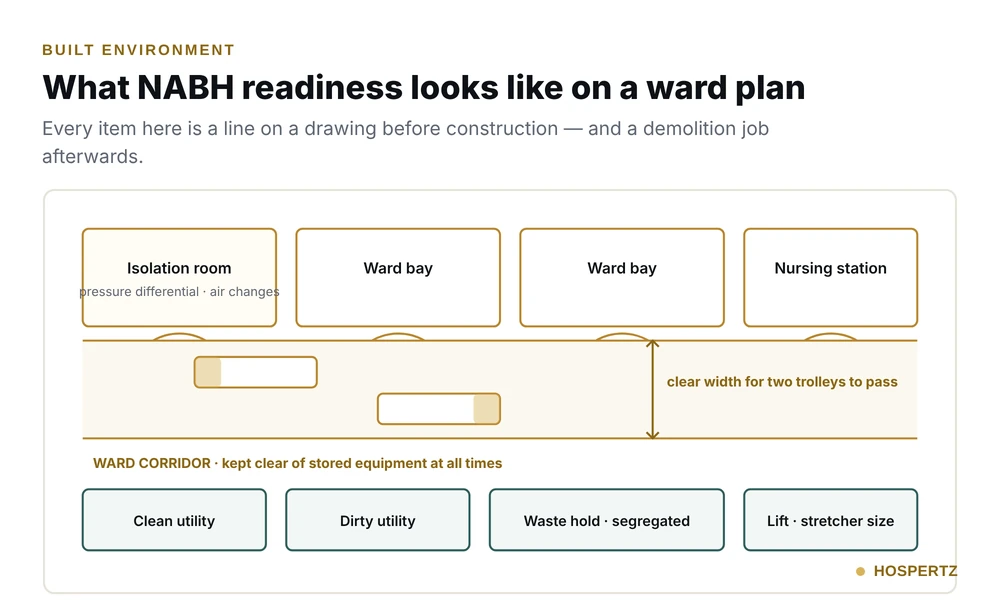
The items that are most expensive to fix after commissioning are nearly always physical: corridor widths, isolation room pressure differentials and air changes, separation of clean and dirty circulation routes in the OT complex, fire compartmentation, and biomedical waste segregation and storage areas. Each of these is a line on an architect’s drawing before construction and a demolition job afterwards.
NABH has also notified specific fire safety requirements for healthcare organisations keyed to building height, aligned with the National Building Code of India. A hospital crossing the 15-metre or 24-metre height thresholds faces materially different requirements — which makes it a structural design decision, not a compliance afterthought.
This is precisely why NABH readiness belongs in the project brief alongside the bed count and the specialities, not in a consultant’s scope eighteen months after the building is finished.
class="attachment-full size-full wp-image-6836" alt="" srcset="https://www.hospertz.com/wp-content/uploads/2026/10/hospital-ward-nabh-readiness-india.webp 1000w, https://www.hospertz.com/wp-content/uploads/2026/10/hospital-ward-nabh-readiness-india-300x180.webp 300w, https://www.hospertz.com/wp-content/uploads/2026/10/hospital-ward-nabh-readiness-india-768x461.webp 768w, https://www.hospertz.com/wp-content/uploads/2026/10/hospital-ward-nabh-readiness-india-125x75.webp 125w, https://www.hospertz.com/wp-content/uploads/2026/10/hospital-ward-nabh-readiness-india-480x288.webp 480w, https://www.hospertz.com/wp-content/uploads/2026/10/hospital-ward-nabh-readiness-india-24x14.webp 24w, https://www.hospertz.com/wp-content/uploads/2026/10/hospital-ward-nabh-readiness-india-36x22.webp 36w, https://www.hospertz.com/wp-content/uploads/2026/10/hospital-ward-nabh-readiness-india-48x29.webp 48w" sizes="(max-width:767px) 480px, (max-width:1000px) 100vw, 1000px" /> Hospital ward corridor meeting NABH infrastructure and safety requirements

Our doctors, healthcare architects and NABH consultants will review your plan, budget and timeline.
Where to verify the details
Programme notifications, fee structures and implementation plans are published directly by NABH on its announcements page, and documentation frameworks are available through NABH E-Mitra. Because notifications are issued regularly and implementation dates shift, always confirm against the current notification before committing to a pathway.
If you want the full process walked through end to end, our step-by-step NABH accreditation guide covers the application sequence, documentation and assessment stages in detail.
The bottom line
For most hospitals, this change is administrative. For hospitals above 300 beds that were relying on HOPE, it is a change in strategy, budget and timeline — and the cost of getting it wrong is measured in empanelment disruption rather than in consultancy fees.
Confirm your bed strength, confirm your eligible pathway, and start your indicator data collection this quarter rather than next.
Written by Dr. Vishal Jadhav, Founder & Director, Hospertz India Pvt Ltd. Last reviewed: October 2026.
Need help choosing the right NABH pathway for your hospital? Hospertz provides NABH consultancy support — gap assessment, documentation, SOP development and assessment readiness — for hospitals, clinics and diagnostic centres across India. Get a free consultation →
Frequently asked questions
Can a hospital above 300 beds still renew its existing HOPE certification?
Generally no. Notification NABH/Gen/2025/3798 provides that no fresh or renewal HOPE applications will be accepted from hospitals above 300 beds after 1 October 2026, and that such hospitals should transition to the Hospital Accreditation Programme. Two exceptions are written in: government-owned hospitals of any size, and hospitals above 300 beds newly commissioned on or after 1 October 2026, which may take one certification cycle. Because NABH issues notifications regularly, confirm your position against the current notification on nabh.co before planning a renewal.
Is eligibility based on sanctioned beds or operational beds?
Sanctioned beds. This catches out phased greenfield projects in particular: a hospital that has commissioned 180 beds but holds sanction for 400 is assessed as a 400-bed facility. Verify the figure against your clinical establishment registration and approved building plans rather than an internal bed census.
How long does 6th edition readiness take compared with entry level?
Entry-level readiness can sometimes be achieved in a few months because it is largely a documentation exercise. Full 6th edition readiness takes considerably longer because assessors evaluate demonstrated practice — functioning committees with minutes, trained staff, closed audit actions and quality indicator data with history. The indicator history is usually the binding constraint.
Which NABH programme applies to a hospital with fewer than 50 beds?
Up to 50 beds, the SHCO (Small Healthcare Organisation) standards apply, with requirements proportionate to scale. Between 51 and 300 beds, a hospital can go for full HCO accreditation or take entry-level certification first as a stepping stone — a staged route that remains legitimate and is often the sensible one.
We are still under construction. Does this change anything for us?
Yes, and it is the cheapest point at which to respond. If the project will cross 300 beds, design for the 6th edition now. Corridor and door widths, isolation room pressure differentials, clean and dirty separation in the OT complex, fire compartmentation and biomedical waste routes are drawing-board decisions before construction and demolition jobs afterwards.
class="attachment-full size-full wp-image-6847" alt="" srcset="https://www.hospertz.com/wp-content/uploads/2026/10/vishal-Jadhav-5.png 500w, https://www.hospertz.com/wp-content/uploads/2026/10/vishal-Jadhav-5-300x300.png 300w, https://www.hospertz.com/wp-content/uploads/2026/10/vishal-Jadhav-5-150x150.png 150w, https://www.hospertz.com/wp-content/uploads/2026/10/vishal-Jadhav-5-75x75.png 75w, https://www.hospertz.com/wp-content/uploads/2026/10/vishal-Jadhav-5-480x480.png 480w, https://www.hospertz.com/wp-content/uploads/2026/10/vishal-Jadhav-5-24x24.png 24w, https://www.hospertz.com/wp-content/uploads/2026/10/vishal-Jadhav-5-36x36.png 36w, https://www.hospertz.com/wp-content/uploads/2026/10/vishal-Jadhav-5-48x48.png 48w" sizes="(max-width:767px) 480px, 500px" /> Founder and Director of Hospertz. After a career in medicine, Dr. Vishal moved into corporate healthcare and now leads a team of healthcare architects, NABH consultants and project managers who plan and build hospitals, clinics and diagnostic centres across India.
Related guides
Turn this guide into a plan for your hospital.
Get a free first consultation on feasibility, licences, budget and timelines from the Hospertz team in Mumbai, Bhopal or Chhattisgarh.