PMJAY De-Empanelment: How to Protect Your Hospital in 2026
October 17, 2026NABH 6th Edition: The Full Requirements Checklist for 2026
October 21, 2026Tier-2 & Tier-3 Hospital Investment in India: The 2026 Case

Tier-2 and Tier-3 Hospital Investment in India: Why the Money Is Moving Out of the Metros
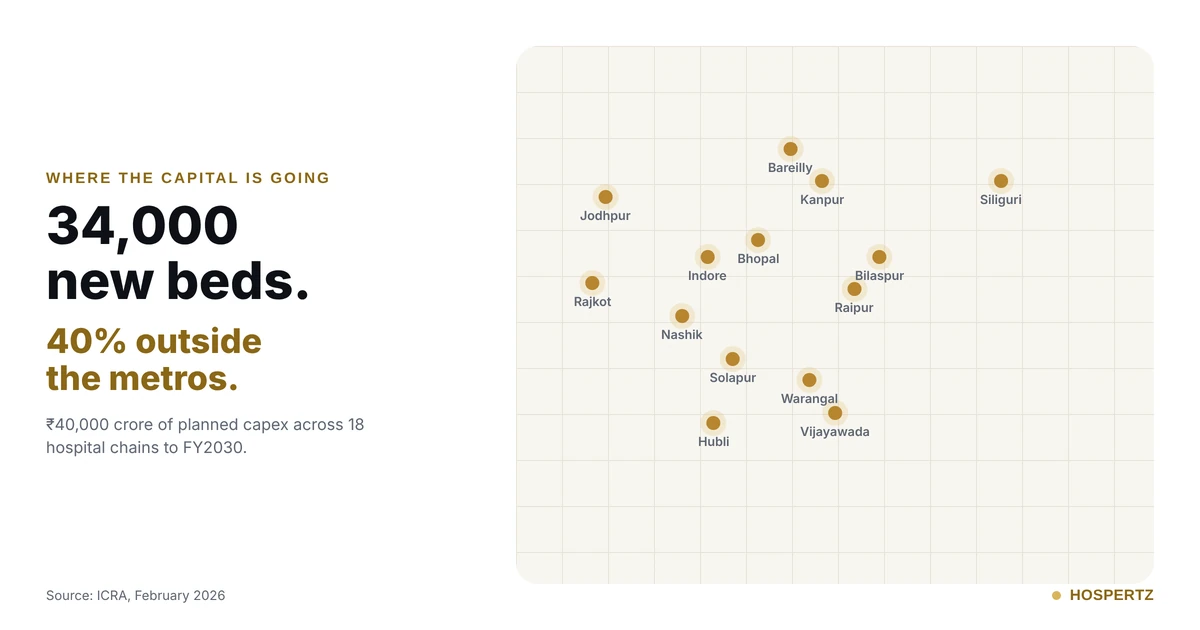
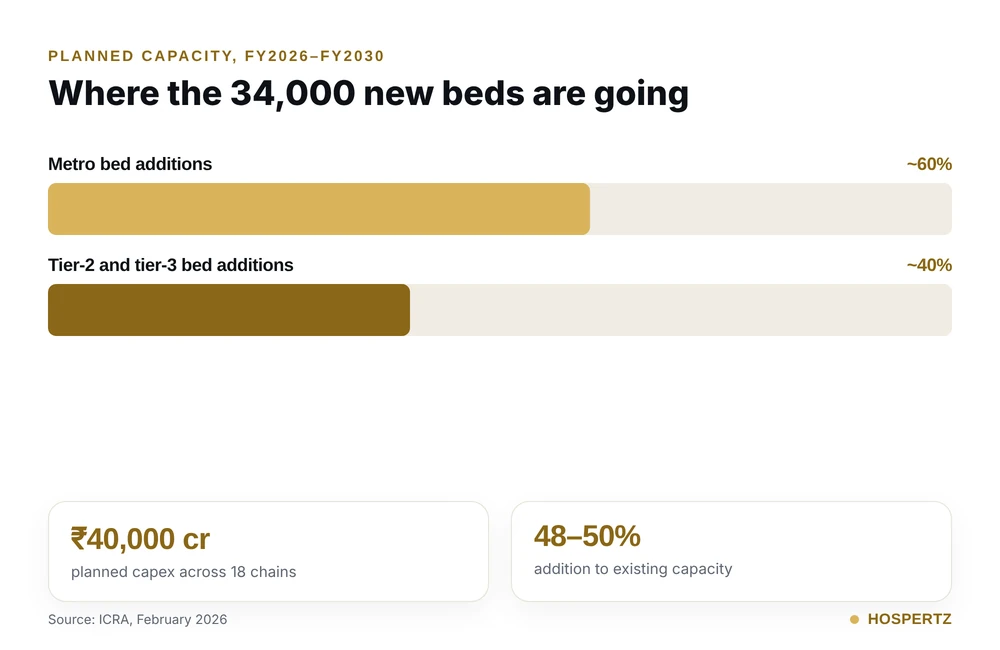
Institutional capital has decisively turned towards smaller Indian cities: around 40% of the 34,000 beds and ₹40,000 crore of capex planned by 18 large chains through FY2030 is aimed at tier-2 and tier-3 locations. This guide explains why the economics work outside the metros and gives you seven criteria for screening a specific town.
class="attachment-full size-full wp-image-6909" alt="" srcset="https://www.hospertz.com/wp-content/uploads/2026/10/vishal-Jadhav-8.png 500w, https://www.hospertz.com/wp-content/uploads/2026/10/vishal-Jadhav-8-300x300.png 300w, https://www.hospertz.com/wp-content/uploads/2026/10/vishal-Jadhav-8-150x150.png 150w, https://www.hospertz.com/wp-content/uploads/2026/10/vishal-Jadhav-8-75x75.png 75w, https://www.hospertz.com/wp-content/uploads/2026/10/vishal-Jadhav-8-480x480.png 480w, https://www.hospertz.com/wp-content/uploads/2026/10/vishal-Jadhav-8-24x24.png 24w, https://www.hospertz.com/wp-content/uploads/2026/10/vishal-Jadhav-8-36x36.png 36w, https://www.hospertz.com/wp-content/uploads/2026/10/vishal-Jadhav-8-48x48.png 48w" sizes="(max-width:767px) 480px, 500px" /> Dr. Vishal Jadhav · Founder, Hospertz
16 October 2026 6 min read
class="attachment-full size-full wp-image-6918" alt="" srcset="https://www.hospertz.com/wp-content/uploads/2026/10/tier-2-tier-3-hospital-investment-opportunity-india-map.webp 1200w, https://www.hospertz.com/wp-content/uploads/2026/10/tier-2-tier-3-hospital-investment-opportunity-india-map-300x158.webp 300w, https://www.hospertz.com/wp-content/uploads/2026/10/tier-2-tier-3-hospital-investment-opportunity-india-map-1024x538.webp 1024w, https://www.hospertz.com/wp-content/uploads/2026/10/tier-2-tier-3-hospital-investment-opportunity-india-map-768x403.webp 768w, https://www.hospertz.com/wp-content/uploads/2026/10/tier-2-tier-3-hospital-investment-opportunity-india-map-143x75.webp 143w, https://www.hospertz.com/wp-content/uploads/2026/10/tier-2-tier-3-hospital-investment-opportunity-india-map-480x252.webp 480w, https://www.hospertz.com/wp-content/uploads/2026/10/tier-2-tier-3-hospital-investment-opportunity-india-map-24x13.webp 24w, https://www.hospertz.com/wp-content/uploads/2026/10/tier-2-tier-3-hospital-investment-opportunity-india-map-36x19.webp 36w, https://www.hospertz.com/wp-content/uploads/2026/10/tier-2-tier-3-hospital-investment-opportunity-india-map-48x25.webp 48w" sizes="(max-width:767px) 480px, (max-width:1200px) 100vw, 1200px" /> In this article
- ICRA expects 18 large chains to add 34,000+ beds by FY2030 with ~₹40,000 crore of capex — roughly 40% of it in tier-2 and tier-3 cities.
- Insurance, not population, is the unlock: PMJAY covers ₹5 lakh per family per year across 36,229 empanelled hospitals.
- ICRA points to 200–300 bed tier-2 hospitals serving 1–2 million underserved people reaching EBITDA positive in five to seven years.
- Referral leakage is the single most useful screening metric — it is demonstrated demand, not projected demand.
- Payer mix skews to schemes, so plan materially more working capital headroom than a metro hospital of the same size.
For two decades, the default assumption in Indian hospital development was that serious capital goes to metros. Land was expensive but patients were dense, paying capacity was high, and specialists would actually relocate there.
That assumption is now being actively dismantled by the people deploying the capital.
According to ICRA, a sample set of 18 large hospital chains is expected to add over 34,000 beds between FY2026 and FY2030 — a cumulative 48–50% addition to their existing capacity — entailing investment of around ₹40,000 crore. Roughly 40% of that new capacity is targeted at tier-2 and tier-3 cities.
Private equity has reached the same conclusion. PE and VC investors put more than $14.5 billion into Indian healthcare between 2020 and March 2025, and the current wave of deployment is explicitly aimed at smaller cities. Blackstone-backed Aster DM Quality Care plans to add 5,000 beds targeting underserved smaller Indian cities. PB Health, backed by Policybazaar’s parent, is targeting 150 hospitals across more than 50 cities — 15,000 to 20,000 beds — with expansion beyond the NCR into tier-2 and tier-3 locations.
For a doctor-entrepreneur considering where to build, this is the most important structural shift in the market. Here is what is driving it and how to assess whether a specific town is actually a viable site.
The numbers behind the shift
Three forces are compounding.
Public capacity cannot absorb demand. Public healthcare spending in India remains around 3–3.5% of GDP, with overcrowding and sparse facility availability in both urban and rural regions. The private sector accounts for roughly 62–63% of hospitals and 59–60% of available beds, and dependence on private hospitals is likely to continue over the medium term. In tier-2 and tier-3 districts the gap between demand and quality supply is widest.
Insurance has changed who can pay. This is the real unlock. Historically, the constraint in smaller cities was not patients — it was paying patients. PMJAY now covers ₹5 lakh per family per year, has been extended to all senior citizens aged 70 and above regardless of economic status, and spans 36,229 empanelled hospitals. Add state schemes, growing retail health insurance penetration and corporate cover, and a district-town population that could not previously fund a ₹2 lakh surgery now can.
Unit economics are structurally better outside the metros. ICRA’s analysis points to tier-2 hospitals of 200–300 beds serving a catchment of 1–2 million underserved people reaching EBITDA positive within five to seven years. The drivers are straightforward: land acquisition is a fraction of metro cost, construction is cheaper, and competitive intensity is lower, so you do not need to discount to fill beds. Listed hospital chains also provide a liquid exit pathway, and PE investors have demonstrated 3–5x return potential from Indian hospital chain investments.
class="attachment-full size-full wp-image-6919" alt="" srcset="https://www.hospertz.com/wp-content/uploads/2026/10/hospital-bed-additions-metro-vs-tier-2-india-chart.webp 1000w, https://www.hospertz.com/wp-content/uploads/2026/10/hospital-bed-additions-metro-vs-tier-2-india-chart-300x195.webp 300w, https://www.hospertz.com/wp-content/uploads/2026/10/hospital-bed-additions-metro-vs-tier-2-india-chart-768x499.webp 768w, https://www.hospertz.com/wp-content/uploads/2026/10/hospital-bed-additions-metro-vs-tier-2-india-chart-115x75.webp 115w, https://www.hospertz.com/wp-content/uploads/2026/10/hospital-bed-additions-metro-vs-tier-2-india-chart-480x312.webp 480w, https://www.hospertz.com/wp-content/uploads/2026/10/hospital-bed-additions-metro-vs-tier-2-india-chart-24x16.webp 24w, https://www.hospertz.com/wp-content/uploads/2026/10/hospital-bed-additions-metro-vs-tier-2-india-chart-36x23.webp 36w, https://www.hospertz.com/wp-content/uploads/2026/10/hospital-bed-additions-metro-vs-tier-2-india-chart-48x31.webp 48w" sizes="(max-width:767px) 480px, (max-width:1000px) 100vw, 1000px" /> Where metro projects go wrong, and smaller-city projects go right
The metro hospital problem is that land cost distorts everything downstream. When land is 40–50% of project cost, you need premium tariffs to service the capital, which means you need affluent patients, which means you compete directly with established brands that already have them. Many metro projects are therefore structurally forced into the hardest segment of the market from day one.
In a tier-2 city, land is a much smaller share of project cost. That frees capital for clinical equipment and for talent — the two things that actually determine whether patients choose you. You can be the best-equipped hospital in a district rather than the fourth-best in a metro, and being the best in a district is a far more defensible commercial position.
The trade-off is real and should not be glossed over. Specialist recruitment and retention is harder. Case mix is less predictable. Payer mix skews towards schemes, which means your working capital is exposed to claim-settlement cycles rather than to cash and private insurance. These are solvable problems, but they must be solved deliberately rather than discovered.
class="attachment-full size-full wp-image-6920" alt="" srcset="https://www.hospertz.com/wp-content/uploads/2026/10/hospital-catchment-feasibility-checklist-tier-2.webp 1000w, https://www.hospertz.com/wp-content/uploads/2026/10/hospital-catchment-feasibility-checklist-tier-2-300x210.webp 300w, https://www.hospertz.com/wp-content/uploads/2026/10/hospital-catchment-feasibility-checklist-tier-2-768x538.webp 768w, https://www.hospertz.com/wp-content/uploads/2026/10/hospital-catchment-feasibility-checklist-tier-2-107x75.webp 107w, https://www.hospertz.com/wp-content/uploads/2026/10/hospital-catchment-feasibility-checklist-tier-2-480x336.webp 480w, https://www.hospertz.com/wp-content/uploads/2026/10/hospital-catchment-feasibility-checklist-tier-2-24x17.webp 24w, https://www.hospertz.com/wp-content/uploads/2026/10/hospital-catchment-feasibility-checklist-tier-2-36x25.webp 36w, https://www.hospertz.com/wp-content/uploads/2026/10/hospital-catchment-feasibility-checklist-tier-2-48x34.webp 48w" sizes="(max-width:767px) 480px, (max-width:1000px) 100vw, 1000px" /> What makes a good tier-2 or tier-3 market

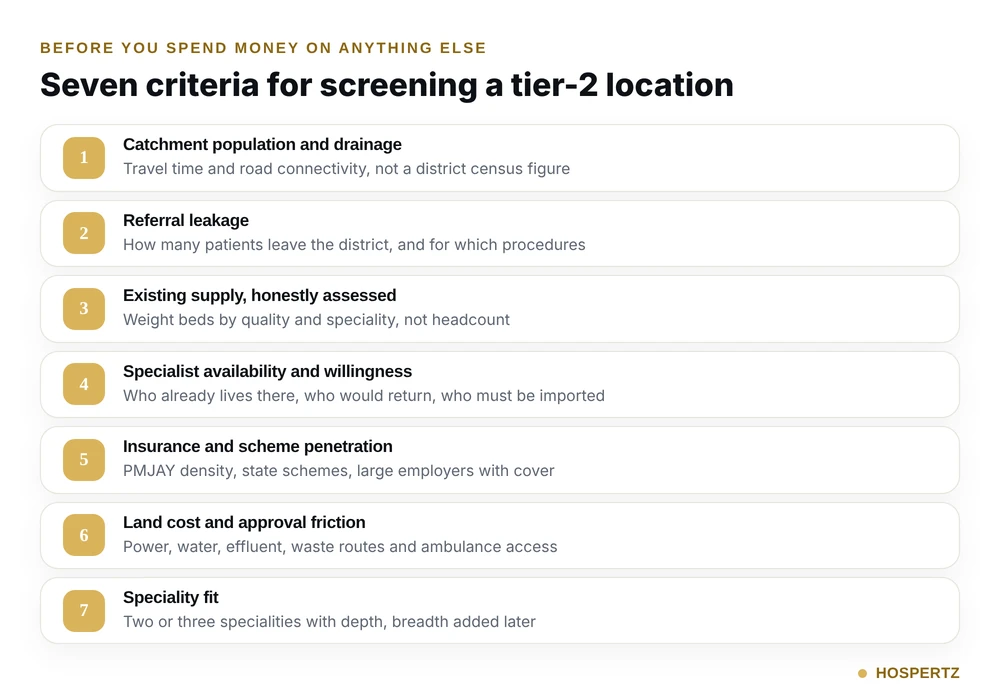
Most failed projects in smaller cities fail on catchment analysis, not on execution. Screen a location against these seven criteria before you spend money on anything else.
- Catchment population and drainage. You need a realistic drainage area, not a district population figure from a census table. Map road connectivity, travel time and where patients currently go. A town of 300,000 that drains a surrounding rural population of 1.2 million is a far better market than a town of 500,000 with a larger hospital 40 kilometres away.
- Referral leakage — the most useful single metric. Find out how many patients currently leave the district for secondary and tertiary care, and for which procedures. Every leaked patient is addressable demand with a demonstrated willingness to travel and pay. Talk to local physicians, diagnostic centres and ambulance operators; they know exactly where patients go and why.
- Existing supply, honestly assessed. Count beds, but weight them by quality and speciality. Twenty nursing-home beds with no ICU and no 24-hour anaesthesia cover are not competition for a planned multispeciality facility.
- Specialist availability and willingness. Identify which consultants already live in or near the town, which would return if the infrastructure existed, and which you would need to import permanently. Doctors who have family roots in a district are dramatically easier to retain than those recruited purely on package.
- Insurance and scheme penetration. Check state scheme coverage in the district, PMJAY empanelment density, and the presence of large employers with corporate cover. This determines your realistic payer mix and therefore your working capital needs.
- Land cost and approval friction. Cheap land with a difficult approval path or inadequate utilities is not cheap. Verify power reliability, water supply, effluent and biomedical waste disposal routes, and road access for ambulances before you commit.
- Speciality fit. Do not build a generic multispeciality hospital. Identify the two or three specialities where leakage is highest and local supply is weakest, build genuine depth there, and add breadth later.
class="attachment-full size-full wp-image-6922" alt="" srcset="https://www.hospertz.com/wp-content/uploads/2026/10/Golden-Hour-Hospital-Showcase.png 1536w, https://www.hospertz.com/wp-content/uploads/2026/10/Golden-Hour-Hospital-Showcase-300x200.png 300w, https://www.hospertz.com/wp-content/uploads/2026/10/Golden-Hour-Hospital-Showcase-1024x683.png 1024w, https://www.hospertz.com/wp-content/uploads/2026/10/Golden-Hour-Hospital-Showcase-768x512.png 768w, https://www.hospertz.com/wp-content/uploads/2026/10/Golden-Hour-Hospital-Showcase-113x75.png 113w, https://www.hospertz.com/wp-content/uploads/2026/10/Golden-Hour-Hospital-Showcase-480x320.png 480w, https://www.hospertz.com/wp-content/uploads/2026/10/Golden-Hour-Hospital-Showcase-24x16.png 24w, https://www.hospertz.com/wp-content/uploads/2026/10/Golden-Hour-Hospital-Showcase-36x24.png 36w, https://www.hospertz.com/wp-content/uploads/2026/10/Golden-Hour-Hospital-Showcase-48x32.png 48w" sizes="(max-width:767px) 480px, (max-width:1536px) 100vw, 1536px" /> How much capital, realistically

Project cost in smaller cities varies enormously with land, bed count, speciality mix and the level of finish — which is why any single per-bed figure quoted online should be treated with suspicion. The honest answer is that it is driven by your specific site and specification.
What is consistent is the shape of the capital requirement. Land and civil works dominate the early phase. Medical equipment is the largest single controllable variable, and the one where phasing saves the most capital — not every planned modality needs to be commissioned in year one. And working capital is where tier-2 projects most often get into trouble: if a meaningful share of your revenue comes from schemes with 15–30 day settlement cycles, you need materially more working capital headroom than a cash-and-private-insurance metro hospital of the same size.
Our detailed breakdown of what it costs to start a hospital in India walks through the cost heads individually.
The strategic choice of route matters as much as the budget. In many smaller cities there are existing underperforming nursing homes and small hospitals available for acquisition, which can shortcut land acquisition, approvals and sometimes an established patient base — at the cost of inheriting someone else’s building constraints. Our comparison of greenfield versus brownfield sets out the trade-offs.
Hospertz tipBefore any catchment study, spend a day with the district’s ambulance operators and diagnostic centre owners. They can tell you within an hour which procedures leave the district, where they go and roughly how many — information that takes a formal study weeks to approximate and that no census table contains.
Our doctors, healthcare architects and NABH consultants will review your plan, budget and timeline.
Three mistakes to avoid
Building metro specifications on a tier-2 revenue base. Imported finishes and a full equipment suite on day one create a cost structure the local tariff cannot service. Specify for your actual market.
Underestimating the clinical talent problem. The building is the easy part. Secure your core consultant team — ideally with equity or long-term commitment — before you break ground, not after you commission.
Treating site selection as a real-estate decision. The site is a clinical and commercial decision that happens to involve land. It determines your catchment, your approvals, your utilities and your ambulance access. Getting choosing your hospital site wrong is the one mistake that cannot be fixed later.
The window
Capital is moving into tier-2 and tier-3 India now, which means two things at once: the thesis is validated, and the best catchments will be taken. Large chains move slowly — board approvals, land assembly, multi-year construction — which leaves a real window for local doctor-entrepreneurs who know their district, can move faster, and already have the clinical reputation that a chain has to buy.
That window is measured in years, not decades.
Written by Dr. Vishal Jadhav, Founder & Director, Hospertz India Pvt Ltd. Last reviewed: October 2026.
Assessing a tier-2 or tier-3 location for a hospital project? Hospertz provides site selection and feasibility analysis — catchment and patient-drainage studies, competitive mapping, capex modelling and break-even analysis — for projects across India. Get a free feasibility consultation →
Frequently asked questions
Why are hospital chains moving into tier-2 and tier-3 cities?
Three forces compound: public capacity cannot absorb demand, insurance and scheme coverage have created paying patients where there were none, and unit economics are structurally better because land is a far smaller share of project cost. ICRA’s analysis points to 200–300 bed tier-2 hospitals reaching EBITDA positive within five to seven years.
What is referral leakage and why does it matter so much?
Referral leakage is the number of patients who currently leave the district for secondary and tertiary care, and the procedures they leave for. It matters because every leaked patient is addressable demand with a demonstrated willingness to travel and pay — which is far stronger evidence than a projection built from population figures.
How much does a hospital in a tier-2 city cost to build?
There is no credible single per-bed figure, because cost is driven by land, bed count, speciality mix and level of finish, and two 100-bed hospitals can differ by multiples. What is consistent is the shape: land and civil works dominate early, medical equipment is the largest controllable variable, and working capital is where tier-2 projects most often get into trouble.
Is it better to build new or acquire an existing nursing home?
It depends on what you are short of. Acquisition can shortcut land acquisition, approvals and sometimes bring an established patient base, at the cost of inheriting someone else’s building constraints — which in a hospital means inheriting their circulation, floor plate and services capacity. Greenfield costs more time and gives you a compliant building.
What is the biggest mistake in a smaller-city hospital project?
Building metro specifications on a tier-2 revenue base. Imported finishes and a full equipment suite on day one create a cost structure the local tariff cannot service. The second biggest is treating site selection as a real-estate decision when it determines catchment, approvals, utilities and ambulance access.
class="attachment-full size-full wp-image-6910" alt="" srcset="https://www.hospertz.com/wp-content/uploads/2026/10/vishal-Jadhav-9.png 500w, https://www.hospertz.com/wp-content/uploads/2026/10/vishal-Jadhav-9-300x300.png 300w, https://www.hospertz.com/wp-content/uploads/2026/10/vishal-Jadhav-9-150x150.png 150w, https://www.hospertz.com/wp-content/uploads/2026/10/vishal-Jadhav-9-75x75.png 75w, https://www.hospertz.com/wp-content/uploads/2026/10/vishal-Jadhav-9-480x480.png 480w, https://www.hospertz.com/wp-content/uploads/2026/10/vishal-Jadhav-9-24x24.png 24w, https://www.hospertz.com/wp-content/uploads/2026/10/vishal-Jadhav-9-36x36.png 36w, https://www.hospertz.com/wp-content/uploads/2026/10/vishal-Jadhav-9-48x48.png 48w" sizes="(max-width:767px) 480px, 500px" /> Founder and Director of Hospertz. After a career in medicine, Dr. Vishal moved into corporate healthcare and now leads a team of healthcare architects, NABH consultants and project managers who plan and build hospitals, clinics and diagnostic centres across India.
Related guides
Turn this guide into a plan for your hospital.
Get a free first consultation on feasibility, licences, budget and timelines from the Hospertz team in Mumbai, Bhopal or Chhattisgarh.