
ABDM Compliance for Hospitals: ABHA, HIS & What’s Required
October 24, 2026Planning a New Hospital: The Seven Stages from Feasibility to Opening Day
October 31, 2026How Long Does It Take to Build a Hospital in India?

How Long Does It Take to Build a Hospital in India? A Realistic Timeline
Hospital project duration depends on your route, scale and location — but the sequence and the dependencies are predictable. This guide sets out the six phases of an Indian hospital project, what governs the length of each, the six causes that account for nearly all significant delay, and where time can genuinely be recovered.
class="attachment-full size-full wp-image-7178" alt="" srcset="https://www.hospertz.com/wp-content/uploads/2026/10/vishal-Jadhav-20.png 500w, https://www.hospertz.com/wp-content/uploads/2026/10/vishal-Jadhav-20-300x300.png 300w, https://www.hospertz.com/wp-content/uploads/2026/10/vishal-Jadhav-20-150x150.png 150w, https://www.hospertz.com/wp-content/uploads/2026/10/vishal-Jadhav-20-75x75.png 75w, https://www.hospertz.com/wp-content/uploads/2026/10/vishal-Jadhav-20-480x480.png 480w, https://www.hospertz.com/wp-content/uploads/2026/10/vishal-Jadhav-20-24x24.png 24w, https://www.hospertz.com/wp-content/uploads/2026/10/vishal-Jadhav-20-36x36.png 36w, https://www.hospertz.com/wp-content/uploads/2026/10/vishal-Jadhav-20-48x48.png 48w" sizes="(max-width:767px) 480px, 500px" /> Dr. Vishal Jadhav · Founder, Hospertz
16 October 2026 6 min read
class="attachment-full size-full wp-image-7187" alt="" srcset="https://www.hospertz.com/wp-content/uploads/2026/10/hospital-project-timeline-phases-india-hospertz.webp 1200w, https://www.hospertz.com/wp-content/uploads/2026/10/hospital-project-timeline-phases-india-hospertz-300x158.webp 300w, https://www.hospertz.com/wp-content/uploads/2026/10/hospital-project-timeline-phases-india-hospertz-1024x538.webp 1024w, https://www.hospertz.com/wp-content/uploads/2026/10/hospital-project-timeline-phases-india-hospertz-768x403.webp 768w, https://www.hospertz.com/wp-content/uploads/2026/10/hospital-project-timeline-phases-india-hospertz-143x75.webp 143w, https://www.hospertz.com/wp-content/uploads/2026/10/hospital-project-timeline-phases-india-hospertz-480x252.webp 480w, https://www.hospertz.com/wp-content/uploads/2026/10/hospital-project-timeline-phases-india-hospertz-24x13.webp 24w, https://www.hospertz.com/wp-content/uploads/2026/10/hospital-project-timeline-phases-india-hospertz-36x19.webp 36w, https://www.hospertz.com/wp-content/uploads/2026/10/hospital-project-timeline-phases-india-hospertz-48x25.webp 48w" sizes="(max-width:767px) 480px, (max-width:1200px) 100vw, 1200px" /> In this article
- Six phases: feasibility and DPR, land and approvals, design, construction, equipment and fit-out, then commissioning and licensing.
- Approvals are the single most variable phase, and resubmission — not the queue — is the real cost.
- Equipment procurement must start during construction, not after it, or its entire lead time is added to your schedule.
- Freezing the clinical brief before detailed design begins is the discipline that saves the most time on any hospital project.
- Phased commissioning — OPD and diagnostics first — is the most under-used time and cash recovery strategy available.
This is the second question every doctor asks, right after cost. It is also the question most consultants answer badly — either with an optimistic number to win the work, or with a vague “depends on many factors” that helps nobody.
The honest answer has two parts. The duration depends on your route, scale and location. But the sequence and the dependencies are predictable, and once you understand them you can both plan realistically and identify where time can actually be recovered.
Here is the phase-by-phase structure of an Indian hospital project, what governs each phase’s length, and the six things that genuinely cause delay.
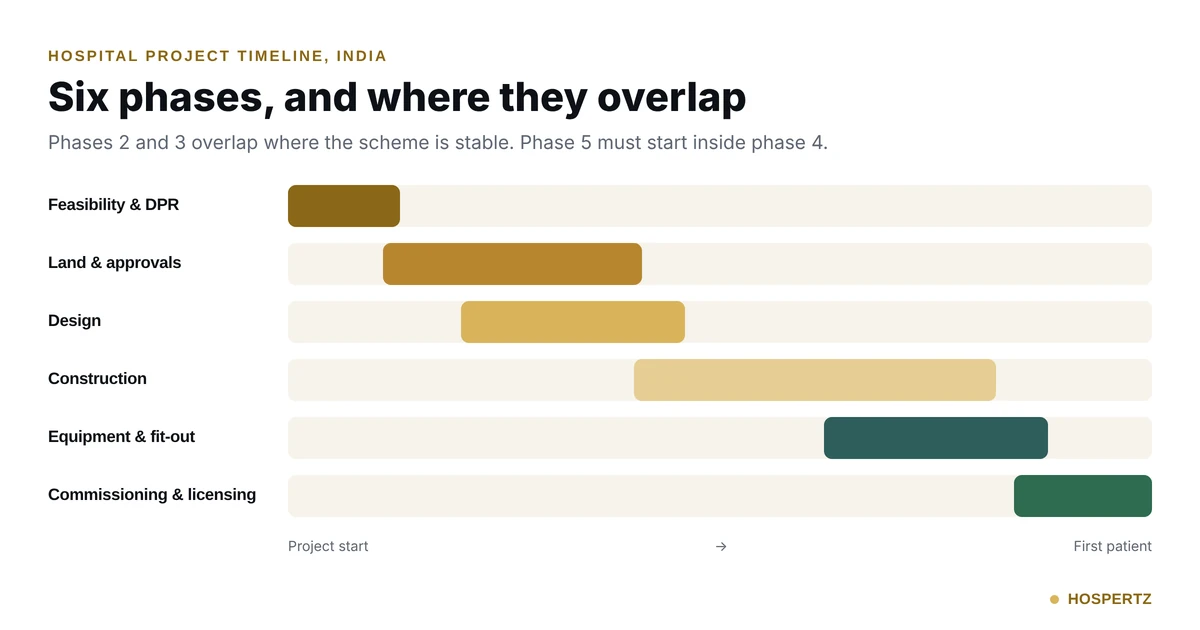
The six phases
| Phase | What happens | What governs its length |
|---|---|---|
| 1. Feasibility & DPR | Catchment and patient-drainage study, competitive mapping, speciality and bed-count decision, capex model, break-even analysis, Detailed Project Report | How quickly you can get local market data and how decisively the promoter group decides |
| 2. Land & approvals | Site acquisition or lease, title due diligence, change of land use where required, building plan sanction, environmental and local body clearances | Almost entirely the local authority. The single most variable phase. |
| 3. Design | Concept, schematic, detailed architectural drawings, structural design, MEP and medical gas design, interior design, tender drawings | Promoter decision-making speed, and whether requirements are frozen or keep changing |
| 4. Construction | Foundation, structure, envelope, internal walls, MEP rough-in, finishes | Bed count, floors, structural system, site constraints, monsoon, contractor capability |
| 5. Equipment & fit-out | Equipment specification, procurement, delivery, installation, commissioning; furniture, HIS, signage | Lead times on major modalities, and import timelines where applicable |
| 6. Commissioning & licensing | System testing, fire NOC, clinical establishment registration, staff recruitment and training, trial runs, soft launch | Licensing authority turnaround, and how early recruitment started |
Three observations matter more than any duration estimate.
Phases 2 and 3 can overlap substantially — design development can proceed while approvals are in process, provided the scheme is stable enough that you are not redesigning after sanction.
Phase 5 must start during Phase 4, not after. Equipment procurement that begins when construction finishes adds its entire lead time to your total timeline. Major imaging modalities have long lead times and specific site requirements — slab loading, shielding, chiller capacity, door openings — which means they have to be specified while you can still change the building.
Phase 6 is almost always underestimated. Owners mentally finish the project when construction finishes. In reality, system testing, statutory clearances, recruitment and staff training sit between a completed building and a hospital with patients in it.
What actually causes delay
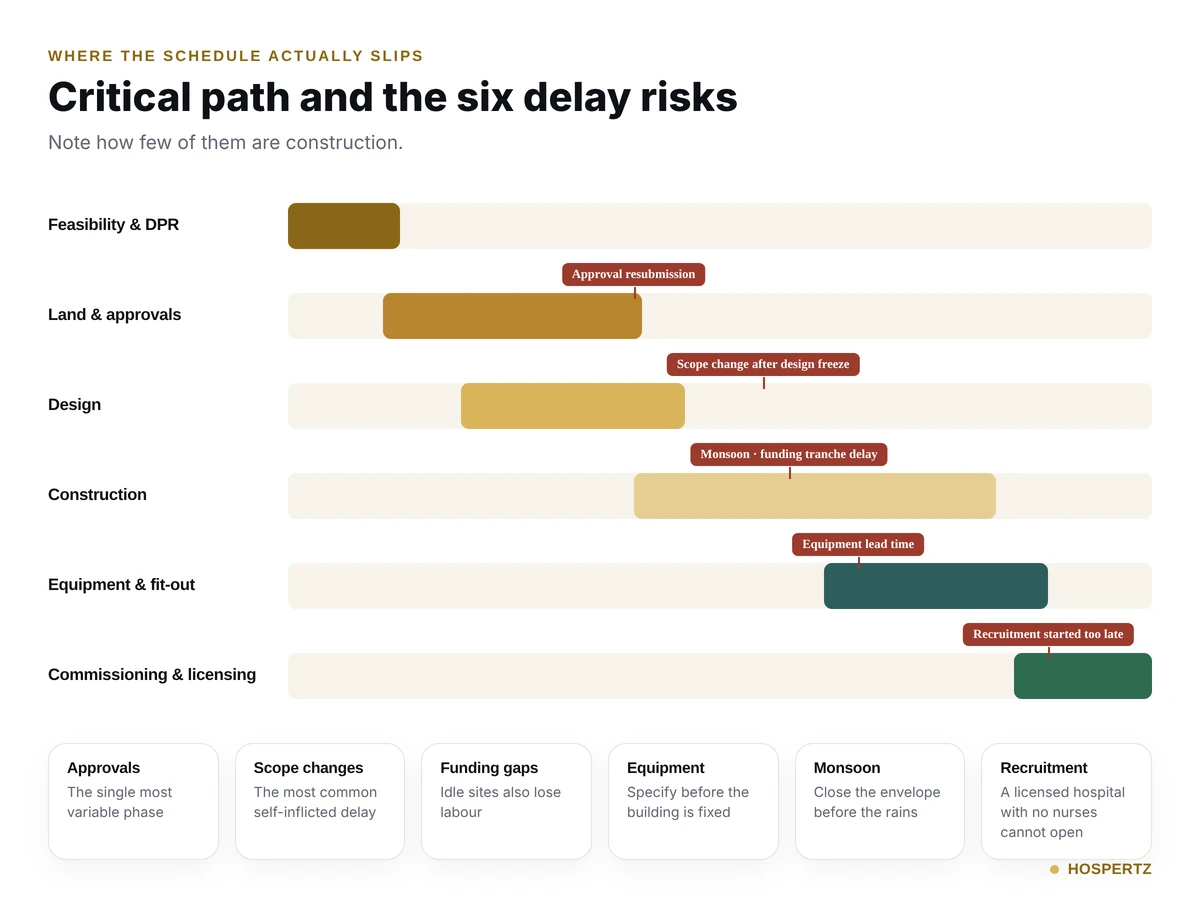
In our experience across projects in Maharashtra, Madhya Pradesh, Chhattisgarh, Uttar Pradesh, Andhra Pradesh and Tamil Nadu, six causes account for nearly all significant slippage. Note how few of them are construction.
1. Approvals — the largest single variable
Building plan sanction and associated clearances vary enormously between municipal corporations, municipal councils and development authorities, and between states. Two identical hospitals in two districts can have materially different approval timelines.
What helps: local knowledge of the specific authority’s requirements and process; complete, correct submissions first time (resubmission is the real cost, not the queue); and parallel processing of independent approvals rather than serial. What does not help: assuming the timeline you experienced on a commercial building applies to a hospital.
2. Scope changes after design freeze
The most common self-inflicted delay. The promoter group adds a speciality, changes the bed count, upgrades a modality or revises the layout after drawings are issued. Each change ripples through structure, MEP, medical gas, tender documents and often the sanctioned plan — which can mean re-sanction.
The discipline that saves the most time on any hospital project is freezing the clinical brief before detailed design begins. Spend longer on the brief; spend far less on rework.
3. Funding tranches arriving late
Construction stops when payments stop. Where funding is milestone-linked — bank disbursement against completion stages, or investor tranches — any gap between the milestone being achieved and the money arriving becomes idle-site time. Idle sites also lose labour, which then has to be remobilised.
Build buffer into your drawdown schedule and keep lender documentation current rather than assembling it when a tranche is due.
4. Equipment lead times and site readiness
Major equipment is where construction and procurement collide. A linear accelerator, MRI or cath lab each carries substantial lead time and demanding site requirements. If the bunker, shielding or slab was not built to the eventual machine’s specification, you are modifying structure late in the project.
The fix is unglamorous: finalise your major equipment selection early enough that the building can be designed around it, even if that means committing to a vendor earlier than feels comfortable commercially.
5. Monsoon
Four months of the year constrain foundation, structure and external works in much of India. A project that reaches foundation stage just before monsoon loses materially more time than one that reaches envelope-closed stage. Where you can, schedule foundation and structure to complete before the rains and internal works to run through them.
6. Recruitment starting too late
The last-mile delay. A completed, licensed, equipped hospital with no nursing staff cannot open. Nurse and technician recruitment, credentialling, and orientation training all take time, and your senior consultants will typically need notice periods served at their current positions.
Recruitment should start well before commissioning, not after. Consultants in particular need to be secured early — ideally during design, since their clinical input improves the design and their commitment de-risks the business case.
class="attachment-full size-full wp-image-7188" alt="" srcset="https://www.hospertz.com/wp-content/uploads/2026/10/hospital-project-critical-path-delay-risk-points.webp 1200w, https://www.hospertz.com/wp-content/uploads/2026/10/hospital-project-critical-path-delay-risk-points-300x225.webp 300w, https://www.hospertz.com/wp-content/uploads/2026/10/hospital-project-critical-path-delay-risk-points-1024x768.webp 1024w, https://www.hospertz.com/wp-content/uploads/2026/10/hospital-project-critical-path-delay-risk-points-768x576.webp 768w, https://www.hospertz.com/wp-content/uploads/2026/10/hospital-project-critical-path-delay-risk-points-100x75.webp 100w, https://www.hospertz.com/wp-content/uploads/2026/10/hospital-project-critical-path-delay-risk-points-960x720.webp 960w, https://www.hospertz.com/wp-content/uploads/2026/10/hospital-project-critical-path-delay-risk-points-480x360.webp 480w, https://www.hospertz.com/wp-content/uploads/2026/10/hospital-project-critical-path-delay-risk-points-24x18.webp 24w, https://www.hospertz.com/wp-content/uploads/2026/10/hospital-project-critical-path-delay-risk-points-36x27.webp 36w, https://www.hospertz.com/wp-content/uploads/2026/10/hospital-project-critical-path-delay-risk-points-48x36.webp 48w" sizes="(max-width:767px) 480px, (max-width:1200px) 100vw, 1200px" /> Where you can genuinely recover time
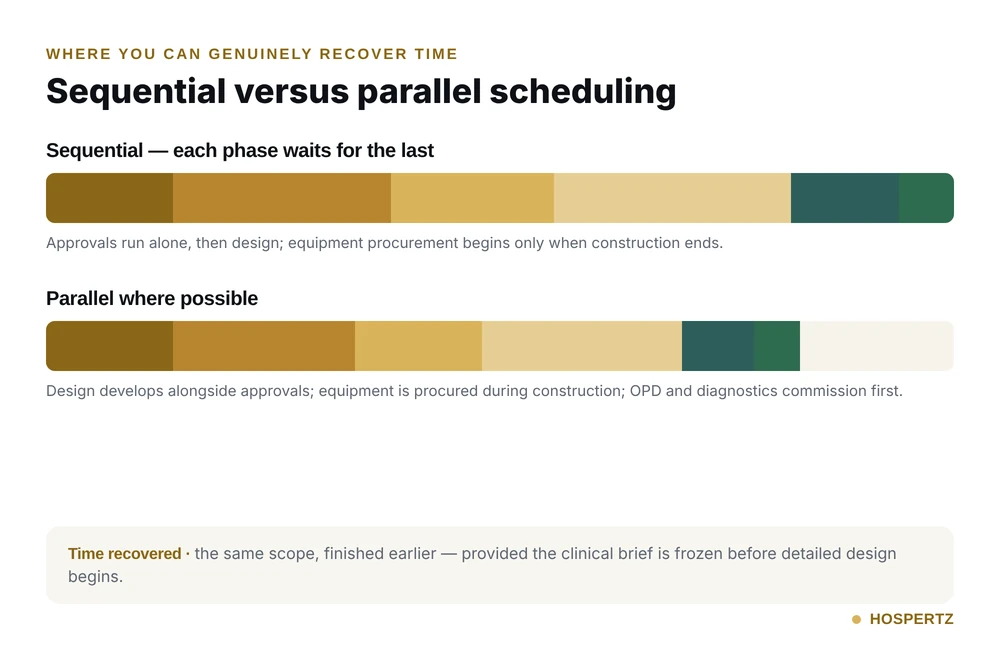
Run approvals and design in parallel. The single biggest lever, provided your scheme is stable.
Start equipment procurement during construction. The second biggest.
Choose brownfield where it fits. Taking over an existing building can shortcut land acquisition and sometimes approvals, at the cost of inheriting structural constraints. See greenfield versus brownfield.
Phase your commissioning. Open OPD and diagnostics first while inpatient areas complete. This starts revenue earlier, builds local awareness before you need beds filled, and lets you bed in operational systems with lower acuity patients. For most projects this is the most under-used strategy available.
Appoint a single accountable party. Projects with an architect, a contractor, an equipment vendor, a licensing agent and a recruitment agency all reporting separately to a promoter who is also practising medicine full-time lose time in the gaps between them. Coordination failure is a schedule risk, not an admin inconvenience — which is the core argument for turnkey project delivery.
class="attachment-full size-full wp-image-7189" alt="" srcset="https://www.hospertz.com/wp-content/uploads/2026/10/hospital-project-sequential-vs-parallel-scheduling.webp 1000w, https://www.hospertz.com/wp-content/uploads/2026/10/hospital-project-sequential-vs-parallel-scheduling-300x195.webp 300w, https://www.hospertz.com/wp-content/uploads/2026/10/hospital-project-sequential-vs-parallel-scheduling-768x499.webp 768w, https://www.hospertz.com/wp-content/uploads/2026/10/hospital-project-sequential-vs-parallel-scheduling-115x75.webp 115w, https://www.hospertz.com/wp-content/uploads/2026/10/hospital-project-sequential-vs-parallel-scheduling-480x312.webp 480w, https://www.hospertz.com/wp-content/uploads/2026/10/hospital-project-sequential-vs-parallel-scheduling-24x16.webp 24w, https://www.hospertz.com/wp-content/uploads/2026/10/hospital-project-sequential-vs-parallel-scheduling-36x23.webp 36w, https://www.hospertz.com/wp-content/uploads/2026/10/hospital-project-sequential-vs-parallel-scheduling-48x31.webp 48w" sizes="(max-width:767px) 480px, (max-width:1000px) 100vw, 1000px" /> Build compliance in, or add it to the timeline
One pattern worth naming: every compliance requirement discovered late becomes a schedule item.
Fire safety requirements are keyed to building height and are structural. NABH’s built-environment requirements — corridor widths, isolation room air changes, separated clean and dirty circulation in the OT complex, biomedical waste routes — are all layout decisions. Discovering any of them after construction means rework, and rework during commissioning is the most expensive time to do anything.
Projects that bring fire, NABH and licensing requirements into the design brief finish faster than projects that treat them as approvals to chase later. This is not a compliance argument; it is a schedule argument.
For the statutory picture, see licences required to open a hospital.
Hospertz tipAsk two or three recent hospital or institutional projects in the same authority’s jurisdiction what their actual plan sanction timeline was. It is the number that varies most between districts, it is the number nobody publishes, and a thirty-minute phone call gives you a better planning assumption than any published average.
class="attachment-full size-full wp-image-7191" alt="" srcset="https://www.hospertz.com/wp-content/uploads/2026/10/ChatGPT-Image-Oct-27-2026-03_11_53-PM.png 1672w, https://www.hospertz.com/wp-content/uploads/2026/10/ChatGPT-Image-Oct-27-2026-03_11_53-PM-300x169.png 300w, https://www.hospertz.com/wp-content/uploads/2026/10/ChatGPT-Image-Oct-27-2026-03_11_53-PM-1024x576.png 1024w, https://www.hospertz.com/wp-content/uploads/2026/10/ChatGPT-Image-Oct-27-2026-03_11_53-PM-768x432.png 768w, https://www.hospertz.com/wp-content/uploads/2026/10/ChatGPT-Image-Oct-27-2026-03_11_53-PM-1536x864.png 1536w, https://www.hospertz.com/wp-content/uploads/2026/10/ChatGPT-Image-Oct-27-2026-03_11_53-PM-133x75.png 133w, https://www.hospertz.com/wp-content/uploads/2026/10/ChatGPT-Image-Oct-27-2026-03_11_53-PM-1200x675.png 1200w, https://www.hospertz.com/wp-content/uploads/2026/10/ChatGPT-Image-Oct-27-2026-03_11_53-PM-480x270.png 480w, https://www.hospertz.com/wp-content/uploads/2026/10/ChatGPT-Image-Oct-27-2026-03_11_53-PM-24x14.png 24w, https://www.hospertz.com/wp-content/uploads/2026/10/ChatGPT-Image-Oct-27-2026-03_11_53-PM-36x20.png 36w, https://www.hospertz.com/wp-content/uploads/2026/10/ChatGPT-Image-Oct-27-2026-03_11_53-PM-48x27.png 48w" sizes="(max-width:767px) 480px, (max-width:1672px) 100vw, 1672px" /> Our doctors, healthcare architects and NABH consultants will review your plan, budget and timeline.

How to answer this question for your own project
Rather than taking a generic duration from the internet, build your own timeline:
- Establish your local approval reality. Ask two or three recent hospital or institutional projects in the same authority’s jurisdiction what their actual sanction timeline was. This is the number that varies most and that nobody publishes.
- Fix your clinical brief. Bed count, specialities, major equipment. Then freeze it.
- Identify your longest equipment lead time. That item sets a hard constraint on your earliest possible opening.
- Map your funding drawdowns against construction milestones and add buffer.
- Work backwards from your target opening to find when recruitment and licensing must start.
- Add contingency. Not because the plan is wrong, but because approvals and funding are substantially outside your control.
A timeline built this way is defensible to a lender, usable by your project team, and — most importantly — actually achievable. For the cost side of the same analysis, see hospital project cost.
Written by Dr. Vishal Jadhav, Founder & Director, Hospertz India Pvt Ltd. Last reviewed: October 2026.
Planning a hospital project and need a realistic schedule and budget? Hospertz delivers hospital projects end to end — feasibility and DPR, design, approvals, construction coordination, equipment and commissioning — as one accountable partner. Get a free feasibility consultation →
Frequently asked questions
How long does it take to build a hospital in India?
It depends on route, scale and location — above all on your local approval authority, which is the single most variable phase. What is predictable is the sequence: feasibility and DPR, land and approvals, design, construction, equipment and fit-out, then commissioning and licensing. Build your timeline from your own approval reality and longest equipment lead time rather than from a generic published figure.
Which phase of a hospital project causes the most delay?
Land and approvals. Building plan sanction and associated clearances vary enormously between municipal corporations, municipal councils and development authorities, and between states — two identical hospitals in two districts can have materially different timelines. Complete, correct first-time submissions matter more than anything else, because resubmission is the real cost.
Can design and approvals run in parallel?
Yes, and it is the single biggest time lever available — provided the scheme is stable enough that you are not redesigning after sanction. The second biggest is starting equipment procurement during construction rather than after it.
When should hospital recruitment start?
Well before commissioning. A completed, licensed, equipped hospital with no nursing staff cannot open, and nurse and technician recruitment, credentialling and orientation all take time while senior consultants serve notice periods. Consultants should ideally be secured during design, since their clinical input improves the building and their commitment de-risks the business case.
Does phased commissioning actually help?
Substantially, and it is under-used. Opening OPD and diagnostics while inpatient areas complete starts revenue earlier, builds local awareness before you need beds filled, and lets you bed in operational systems with lower acuity patients — which is a safer way to discover the gaps in your SOPs than doing it with inpatients.
class="attachment-full size-full wp-image-7179" alt="" srcset="https://www.hospertz.com/wp-content/uploads/2026/10/vishal-Jadhav-21.png 500w, https://www.hospertz.com/wp-content/uploads/2026/10/vishal-Jadhav-21-300x300.png 300w, https://www.hospertz.com/wp-content/uploads/2026/10/vishal-Jadhav-21-150x150.png 150w, https://www.hospertz.com/wp-content/uploads/2026/10/vishal-Jadhav-21-75x75.png 75w, https://www.hospertz.com/wp-content/uploads/2026/10/vishal-Jadhav-21-480x480.png 480w, https://www.hospertz.com/wp-content/uploads/2026/10/vishal-Jadhav-21-24x24.png 24w, https://www.hospertz.com/wp-content/uploads/2026/10/vishal-Jadhav-21-36x36.png 36w, https://www.hospertz.com/wp-content/uploads/2026/10/vishal-Jadhav-21-48x48.png 48w" sizes="(max-width:767px) 480px, 500px" /> Founder and Director of Hospertz. After a career in medicine, Dr. Vishal moved into corporate healthcare and now leads a team of healthcare architects, NABH consultants and project managers who plan and build hospitals, clinics and diagnostic centres across India.
Related guides
Turn this guide into a plan for your hospital.
Get a free first consultation on feasibility, licences, budget and timelines from the Hospertz team in Mumbai, Bhopal or Chhattisgarh.