
Hospital Fire Safety in India: NBC & NABH Design Requirements
October 24, 2026How Long Does It Take to Build a Hospital in India?
October 27, 2026ABDM Compliance for Hospitals: ABHA, HIS & What’s Required

ABDM Compliance for Hospitals: What ABHA, HIS and Digital Health Actually Require
ABDM integration is now effectively mandatory for PMJAY empanelment and claims, and NABH has put digital health at the centre of accreditation with draft standards running to 8 chapters, 38 standards and 181 objective elements. This guide covers the four ABDM building blocks, what your HIS actually has to do, and the four places it breaks in practice.
class="attachment-full size-full wp-image-7114" alt="" srcset="https://www.hospertz.com/wp-content/uploads/2026/10/vishal-Jadhav-18.png 500w, https://www.hospertz.com/wp-content/uploads/2026/10/vishal-Jadhav-18-300x300.png 300w, https://www.hospertz.com/wp-content/uploads/2026/10/vishal-Jadhav-18-150x150.png 150w, https://www.hospertz.com/wp-content/uploads/2026/10/vishal-Jadhav-18-75x75.png 75w, https://www.hospertz.com/wp-content/uploads/2026/10/vishal-Jadhav-18-480x480.png 480w, https://www.hospertz.com/wp-content/uploads/2026/10/vishal-Jadhav-18-24x24.png 24w, https://www.hospertz.com/wp-content/uploads/2026/10/vishal-Jadhav-18-36x36.png 36w, https://www.hospertz.com/wp-content/uploads/2026/10/vishal-Jadhav-18-48x48.png 48w" sizes="(max-width:767px) 480px, 500px" /> Dr. Vishal Jadhav · Founder, Hospertz
16 October 2026 6 min read
class="attachment-full size-full wp-image-7123" alt="" srcset="https://www.hospertz.com/wp-content/uploads/2026/10/abdm-hospital-integration-abha-hfr-hpr-architecture.webp 1200w, https://www.hospertz.com/wp-content/uploads/2026/10/abdm-hospital-integration-abha-hfr-hpr-architecture-300x158.webp 300w, https://www.hospertz.com/wp-content/uploads/2026/10/abdm-hospital-integration-abha-hfr-hpr-architecture-1024x538.webp 1024w, https://www.hospertz.com/wp-content/uploads/2026/10/abdm-hospital-integration-abha-hfr-hpr-architecture-768x403.webp 768w, https://www.hospertz.com/wp-content/uploads/2026/10/abdm-hospital-integration-abha-hfr-hpr-architecture-143x75.webp 143w, https://www.hospertz.com/wp-content/uploads/2026/10/abdm-hospital-integration-abha-hfr-hpr-architecture-480x252.webp 480w, https://www.hospertz.com/wp-content/uploads/2026/10/abdm-hospital-integration-abha-hfr-hpr-architecture-24x13.webp 24w, https://www.hospertz.com/wp-content/uploads/2026/10/abdm-hospital-integration-abha-hfr-hpr-architecture-36x19.webp 36w, https://www.hospertz.com/wp-content/uploads/2026/10/abdm-hospital-integration-abha-hfr-hpr-architecture-48x25.webp 48w" sizes="(max-width:767px) 480px, (max-width:1200px) 100vw, 1200px" /> In this article
- ABDM integration is effectively a precondition for PMJAY empanelment and claims; non-compliant hospitals face rejections and de-empanelment risk.
- Four components to engage with: ABHA, the Health Facility Registry, the Healthcare Professionals Registry and the consent-based exchange layer.
- NABH’s draft Digital Health Standards run to 8 chapters, 38 standards and 181 objective elements alongside the hospital standards.
- A hospital that scans paper notes at discharge has a document archive, not an EMR — and the distinction is increasingly assessable.
- Registries drift out of sync: reconcile HFR, clinical establishment registration and empanelment scope every quarter.
Digital health has moved from a differentiator to a precondition. Two developments made that shift concrete.
First, ABDM integration is now effectively mandatory for PMJAY empanelment and for claims processing. Hospitals that are not ABDM-compliant face claim rejections and risk de-empanelment. Patients must be registered using their ABHA ID at the time of admission.
Second, NABH has put digital health at the centre of accreditation. The 6th edition places strong emphasis on how hospitals integrate digital health solutions into operations, and NABH has issued draft Digital Health Standards for hospitals with complementary standards for Hospital Information System and Electronic Medical Record systems — a framework of 8 chapters, 38 standards and 181 objective elements.
Put together: your HIS is no longer an operational convenience. It is infrastructure that your revenue and your accreditation both run through.
Here is what is actually required and where hospitals get stuck.
The four ABDM building blocks
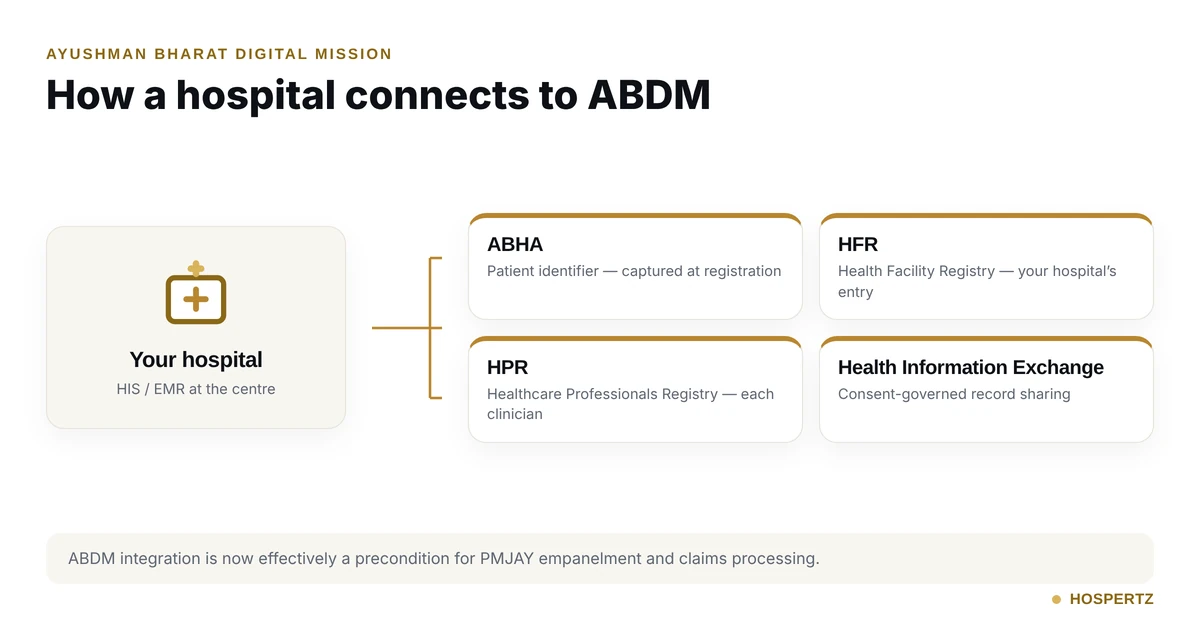
The Ayushman Bharat Digital Mission is a set of national registries and an exchange layer. A hospital interacts with four components.
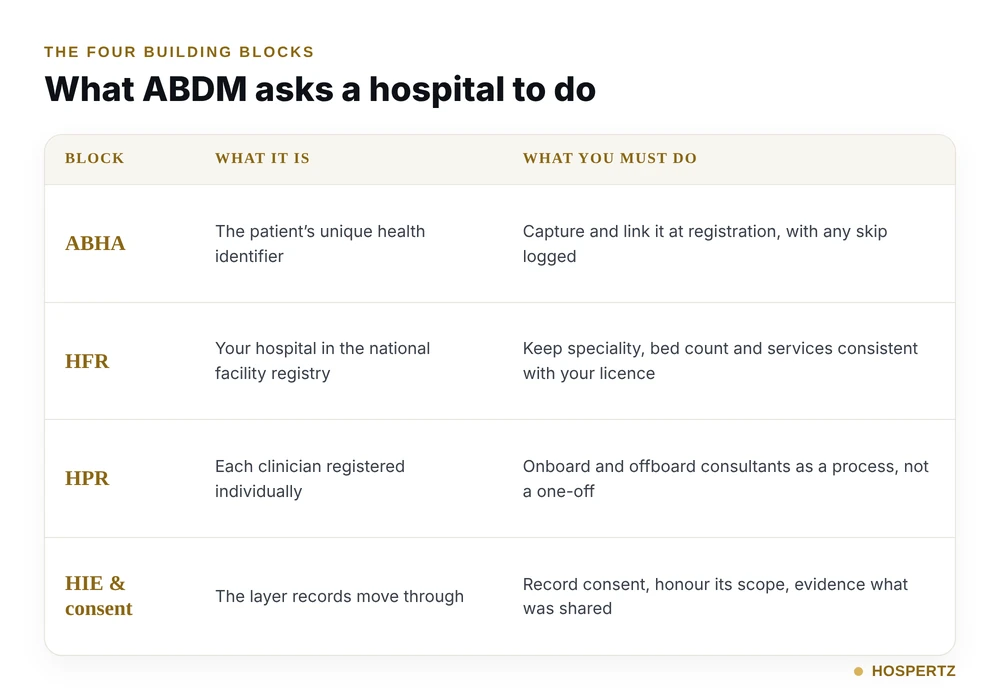
ABHA — Ayushman Bharat Health Account. The patient’s unique health identifier. Your obligation is to capture and link it at registration. For PMJAY beneficiaries this is not optional — admission without a correctly linked ABHA creates a mismatch between your claim and the national record.
HFR — Health Facility Registry. Your hospital’s own entry in the national facility registry. Registration here is a prerequisite for most downstream integration, and the details you enter — speciality, bed count, services — need to match your clinical establishment registration and your empanelment scope. Mismatches between these registries are a recurring source of problems.
HPR — Healthcare Professionals Registry. Your doctors and clinical staff registered individually. Practitioner records need to be current, which means a process for onboarding and offboarding consultants, not a one-time data entry exercise.
Health Information Exchange and consent framework. The layer through which records move between facilities, governed by patient consent. This is the part most hospitals have engaged with least, and the part NABH’s digital health standards focus on most.
Registration pathways and current technical requirements are published by the Ayushman Bharat Digital Mission — verify against the official portal, as integration specifications and milestone certification requirements are revised periodically.
What your HIS actually has to be able to do
This is the practical question, and the answer is more demanding than most hospital owners assume when buying software.
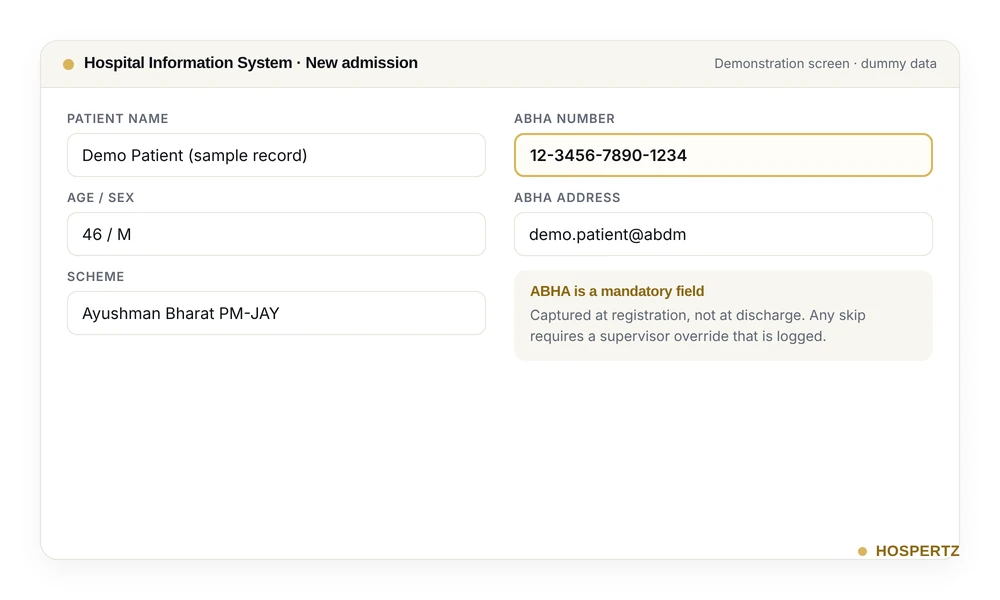
Capture and validate ABHA at registration. Not at discharge, not in a separate module, not in a spreadsheet the billing team maintains. At the point of first contact, in the same screen as the rest of registration.
Create structured, linked clinical records. The record has to be in the system, not scanned into it. A hospital that runs paper notes and scans them at discharge has a document archive, not an EMR, and that distinction is increasingly assessable.
Enforce real access controls. Role-based access, individual logins, audit trails showing who viewed and changed what. The shared-password-at-the-nursing-station practice — extremely common — fails this outright and also fails the records confidentiality requirements under accreditation.
Support consent-based data sharing. Record consent, honour its scope, and be able to show what was shared with whom under which consent.
Produce the data your indicators need. NABH’s expanded quality indicator requirements mean your system has to be able to generate indicator data reliably. If your indicators are compiled manually from registers each month, you have a sustainability problem — and a data integrity problem an assessor can probe.
Support claims end to end. Link the clinical record, the package code and the supporting documents so that a claim can be assembled and defended. This is the direct connection to PMJAY de-empanelment risk: most claim rejections are documentation failures, and a well-configured HIS prevents most of them structurally.
class="attachment-full size-full wp-image-7124" alt="" srcset="https://www.hospertz.com/wp-content/uploads/2026/10/abdm-building-blocks-hospital-requirements-table.webp 1000w, https://www.hospertz.com/wp-content/uploads/2026/10/abdm-building-blocks-hospital-requirements-table-300x210.webp 300w, https://www.hospertz.com/wp-content/uploads/2026/10/abdm-building-blocks-hospital-requirements-table-768x538.webp 768w, https://www.hospertz.com/wp-content/uploads/2026/10/abdm-building-blocks-hospital-requirements-table-107x75.webp 107w, https://www.hospertz.com/wp-content/uploads/2026/10/abdm-building-blocks-hospital-requirements-table-480x336.webp 480w, https://www.hospertz.com/wp-content/uploads/2026/10/abdm-building-blocks-hospital-requirements-table-24x17.webp 24w, https://www.hospertz.com/wp-content/uploads/2026/10/abdm-building-blocks-hospital-requirements-table-36x25.webp 36w, https://www.hospertz.com/wp-content/uploads/2026/10/abdm-building-blocks-hospital-requirements-table-48x34.webp 48w" sizes="(max-width:767px) 480px, (max-width:1000px) 100vw, 1000px" /> The four ABDM building blocks and what each requires from a hospital
Where it breaks in practice
Buying software is the easy part. Four failure patterns recur.
The front desk is the whole system. ABHA capture happens at registration, which means your most junior, highest-turnover, busiest staff are your compliance control point. If capture is optional in the software, it will not happen during a busy OPD morning. Make the field mandatory with a logged supervisor override, and train every shift — including night registration, which is routinely untrained.
Clinicians route around the system. If entering notes in the HIS is slower than writing them, doctors will write them. Then the record is incomplete, the indicators are unreliable and the claim is undefendable. This is a workflow design problem, not a discipline problem. Involve your clinicians in configuration before go-live, and measure adoption afterwards — percentage of discharges with complete electronic records is a far more useful metric than whether the system is installed.
Registries drift out of sync. Your HFR entry says 80 beds, your clinical establishment registration says 100, your empanelment covers five specialities and you are claiming under six. Each of these is individually small and collectively a pattern of irregularity. Reconcile all your registrations quarterly.
Nobody owns it. ABDM compliance sits between IT, medical records, billing and administration, which in many hospitals means it sits nowhere. Name one person accountable.
class="attachment-full size-full wp-image-7125" alt="" srcset="https://www.hospertz.com/wp-content/uploads/2026/10/abha-id-capture-hospital-admission-abdm-1.webp 1000w, https://www.hospertz.com/wp-content/uploads/2026/10/abha-id-capture-hospital-admission-abdm-1-300x180.webp 300w, https://www.hospertz.com/wp-content/uploads/2026/10/abha-id-capture-hospital-admission-abdm-1-768x461.webp 768w, https://www.hospertz.com/wp-content/uploads/2026/10/abha-id-capture-hospital-admission-abdm-1-125x75.webp 125w, https://www.hospertz.com/wp-content/uploads/2026/10/abha-id-capture-hospital-admission-abdm-1-480x288.webp 480w, https://www.hospertz.com/wp-content/uploads/2026/10/abha-id-capture-hospital-admission-abdm-1-24x14.webp 24w, https://www.hospertz.com/wp-content/uploads/2026/10/abha-id-capture-hospital-admission-abdm-1-36x22.webp 36w, https://www.hospertz.com/wp-content/uploads/2026/10/abha-id-capture-hospital-admission-abdm-1-48x29.webp 48w" sizes="(max-width:767px) 480px, (max-width:1000px) 100vw, 1000px" /> Hospital registration desk where ABHA ID capture happens at admission

For new hospitals: build this in at commissioning
If you are setting up a hospital now, digital infrastructure is substantially cheaper and easier to get right at commissioning than to fix later.
During design: plan the physical infrastructure. Structured cabling to every clinical point, wireless coverage designed rather than assumed (hospital construction with dense walls and lead-lined radiology rooms creates dead zones), server room with adequate power and cooling, UPS and generator-backed power to clinical workstations, and redundant internet connectivity. These are architectural and MEP decisions.
During procurement: select an HIS that is already ABDM-integrated and can evidence it. Ask specifically about ABHA capture workflow, HFR/HPR integration, consent management, audit trails and indicator reporting. Ask for a reference hospital of similar size you can call. Do not buy on price per bed alone — a cheap HIS your clinicians will not use is the most expensive option available.
Before go-live: configure around your actual clinical workflows, train by role and by shift, and run a parallel period before switching off paper. Hospitals that switch overnight almost always end up with a gap in their records at the transition, which becomes a permanent hole in their indicator history.
At commissioning: register on HFR, onboard all practitioners to HPR, and make ABHA capture mandatory from your first patient. Starting compliant is far easier than becoming compliant.
The same logic applies to diagnostic centres, where lab information systems and report delivery increasingly need to interoperate — see starting a diagnostic centre.
Hospertz tipMeasure the percentage of discharges with a complete electronic record, monthly, and report it to the quality committee. It is a far more useful adoption metric than whether the HIS is installed, and it surfaces the clinician workflow problem months before an assessor or a claim rejection does.
Our doctors, healthcare architects and NABH consultants will review your plan, budget and timeline.
The direction of travel
Research mapping NABH’s digital health standards against global digital health maturity models identifies the next frontiers as cybersecurity maturity, measurable interoperability, AI governance, equity and patient-generated health data. Those are the areas where the next iteration of standards is likely to push.
The practical implication for a hospital being built today: choose systems that can interoperate and that take security seriously, rather than the cheapest system that satisfies today’s minimum. Replacing a core HIS in a running hospital is one of the most disruptive projects a hospital can undertake.
A short self-assessment
Answer honestly:
- Is ABHA capture mandatory in your registration screen, with overrides logged?
- Is your HFR entry accurate and consistent with your clinical establishment registration?
- Are all practising consultants registered on HPR, with a process for new joiners?
- Do clinicians enter notes in the system, or on paper that gets scanned?
- Does every user have an individual login, with an audit trail?
- Can you generate your NABH quality indicators from the system without manual compilation?
- Is one named person accountable for digital health compliance?
Three or more “no” answers means you have a material exposure on both the claims and the accreditation side.
For the wider empanelment picture, see our guide to hospital empanelment, and for how digital health sits within accreditation, NABH 6th edition requirements.
Written by Dr. Vishal Jadhav, Founder & Director, Hospertz India Pvt Ltd. Last reviewed: October 2026.
Setting up a hospital and specifying its digital infrastructure? Hospertz plans hospital IT and digital health infrastructure as part of turnkey project delivery — from cabling and server-room design through to HIS selection, ABDM readiness and quality indicator configuration. Get a free consultation →
Frequently asked questions
Is ABDM compliance mandatory for hospitals in India?
In practice it now is for any hospital with scheme volume. ABDM integration is effectively mandatory for PMJAY empanelment and claims processing, patients must be registered using their ABHA ID at admission, and non-compliant hospitals face claim rejections and de-empanelment risk. It also feeds directly into NABH’s digital health expectations.
What are ABHA, HFR and HPR?
ABHA (Ayushman Bharat Health Account) is the patient’s unique health identifier, which you capture and link at registration. HFR (Health Facility Registry) is your hospital’s entry in the national facility registry. HPR (Healthcare Professionals Registry) holds your doctors and clinical staff individually. A fourth layer — the health information exchange and consent framework — governs how records move between facilities.
What should we look for when buying an ABDM-ready HIS?
Ask specifically about ABHA capture workflow at registration, HFR and HPR integration, consent management, role-based access with audit trails, and whether it can generate your NABH quality indicators without manual compilation. Ask for a reference hospital of similar size you can call, and do not buy on price per bed alone — a cheap HIS your clinicians will not use is the most expensive option available.
Why do hospitals fail at ABHA capture?
Because capture happens at registration, which means your most junior, highest-turnover and busiest staff are the compliance control point. If the field is optional in the software it will not be filled during a busy OPD morning. Make it mandatory with a logged supervisor override and train every shift, including night registration, which is routinely untrained.
What digital infrastructure should a new hospital plan at design stage?
Structured cabling to every clinical point, wireless coverage designed rather than assumed — dense walls and lead-lined radiology rooms create dead zones — a server room with adequate power and cooling, UPS and generator-backed power to clinical workstations, and redundant internet connectivity. These are architectural and MEP decisions, not IT purchases.
class="attachment-full size-full wp-image-7115" alt="" srcset="https://www.hospertz.com/wp-content/uploads/2026/10/vishal-Jadhav-19.png 500w, https://www.hospertz.com/wp-content/uploads/2026/10/vishal-Jadhav-19-300x300.png 300w, https://www.hospertz.com/wp-content/uploads/2026/10/vishal-Jadhav-19-150x150.png 150w, https://www.hospertz.com/wp-content/uploads/2026/10/vishal-Jadhav-19-75x75.png 75w, https://www.hospertz.com/wp-content/uploads/2026/10/vishal-Jadhav-19-480x480.png 480w, https://www.hospertz.com/wp-content/uploads/2026/10/vishal-Jadhav-19-24x24.png 24w, https://www.hospertz.com/wp-content/uploads/2026/10/vishal-Jadhav-19-36x36.png 36w, https://www.hospertz.com/wp-content/uploads/2026/10/vishal-Jadhav-19-48x48.png 48w" sizes="(max-width:767px) 480px, 500px" /> Founder and Director of Hospertz. After a career in medicine, Dr. Vishal moved into corporate healthcare and now leads a team of healthcare architects, NABH consultants and project managers who plan and build hospitals, clinics and diagnostic centres across India.
Related guides
Turn this guide into a plan for your hospital.
Get a free first consultation on feasibility, licences, budget and timelines from the Hospertz team in Mumbai, Bhopal or Chhattisgarh.