Planning a New Hospital: The Seven Stages from Feasibility to Opening Day
October 31, 2026Healthcare Infrastructure Investment in the Middle East: How Saudi Arabia and the UAE Are Opening the Door
October 31, 2026Right-Sizing a Hospital: Choosing Bed Numbers, Services and Location for a Growing Community

Right-Sizing a Hospital: Choosing Bed Numbers, Services and Location for a Growing Community
The wrong bed count, service mix or site can sink a hospital before it opens. This guide shows how to size a hospital from demand upwards — catchment, payers, referral patterns and growth — with a worked capacity example and a site-selection checklist.
class="attachment-full size-full wp-image-7350" alt="" srcset="https://www.hospertz.com/wp-content/uploads/2026/10/vishal-Jadhav-25.png 500w, https://www.hospertz.com/wp-content/uploads/2026/10/vishal-Jadhav-25-300x300.png 300w, https://www.hospertz.com/wp-content/uploads/2026/10/vishal-Jadhav-25-150x150.png 150w, https://www.hospertz.com/wp-content/uploads/2026/10/vishal-Jadhav-25-75x75.png 75w, https://www.hospertz.com/wp-content/uploads/2026/10/vishal-Jadhav-25-480x480.png 480w, https://www.hospertz.com/wp-content/uploads/2026/10/vishal-Jadhav-25-24x24.png 24w, https://www.hospertz.com/wp-content/uploads/2026/10/vishal-Jadhav-25-36x36.png 36w, https://www.hospertz.com/wp-content/uploads/2026/10/vishal-Jadhav-25-48x48.png 48w" sizes="(max-width:767px) 480px, 500px" /> Dr. Vishal Jadhav · Founder, Hospertz

31 October 2026 5 min read
class="attachment-full size-full wp-image-7361" alt="" srcset="https://www.hospertz.com/wp-content/uploads/2026/10/hospertz-right-sizing-hero-v2.png 1672w, https://www.hospertz.com/wp-content/uploads/2026/10/hospertz-right-sizing-hero-v2-300x169.png 300w, https://www.hospertz.com/wp-content/uploads/2026/10/hospertz-right-sizing-hero-v2-1024x576.png 1024w, https://www.hospertz.com/wp-content/uploads/2026/10/hospertz-right-sizing-hero-v2-768x432.png 768w, https://www.hospertz.com/wp-content/uploads/2026/10/hospertz-right-sizing-hero-v2-1536x864.png 1536w, https://www.hospertz.com/wp-content/uploads/2026/10/hospertz-right-sizing-hero-v2-133x75.png 133w, https://www.hospertz.com/wp-content/uploads/2026/10/hospertz-right-sizing-hero-v2-1200x675.png 1200w, https://www.hospertz.com/wp-content/uploads/2026/10/hospertz-right-sizing-hero-v2-480x270.png 480w, https://www.hospertz.com/wp-content/uploads/2026/10/hospertz-right-sizing-hero-v2-24x14.png 24w, https://www.hospertz.com/wp-content/uploads/2026/10/hospertz-right-sizing-hero-v2-36x20.png 36w, https://www.hospertz.com/wp-content/uploads/2026/10/hospertz-right-sizing-hero-v2-48x27.png 48w" sizes="(max-width:767px) 480px, (max-width:1672px) 100vw, 1672px" /> In this article

- Start from the population and its needs, not from a bed number someone has in mind.
- Bed need is arithmetic: admissions × average length of stay ÷ (365 × target occupancy) — but every input must be evidenced.
- Decide what you will treat, what you will refer and who you will partner with before you size departments.
- Payer rules can shape the business case: in Kenya, for example, different public funds pay for different levels of care.
- Choose a site with room to grow and reliable utilities; expansion space is cheaper to buy now than later.
“How many beds should we build?” is usually the first question a hospital sponsor asks — and it is the wrong place to start. Beds are an output. The inputs are the people the hospital will serve, the conditions they present with, what neighbouring facilities already provide, who will pay, and how fast the community is growing.
Get those inputs right and the bed count, service mix and site almost choose themselves. Get them wrong and even a beautifully designed hospital can run half-empty, or overflow in its first year.
Step 1: Define the catchment honestly
A catchment is the area your patients will realistically come from. Travel time matters more than distance — a 20 km journey on a good road can be shorter than 5 km through congested traffic. For each part of the catchment, build a picture of:
- Population today and projected growth, by age band
- The burden of disease the community actually carries — maternal and child health, trauma, non-communicable disease, infectious disease
- Existing public, private and faith-based facilities, and the services they genuinely deliver (not just their licences)
- Where patients currently travel for care that is not available locally
Some regulators publish this kind of data. Abu Dhabi’s Healthcare Capacity Master Plan is designed to show investors where capacity is needed. In many African markets, the evidence has to be assembled from census data, ministry statistics and local surveys.
Step 2: Decide what you will — and will not — do
No hospital does everything. The service mix should follow the evidence of need, the clinical talent you can realistically recruit, and the referral network around you. Ask, for each service: will we provide it, refer it, or provide it in partnership?
Health systems often formalise this through levels of care. Kenya’s Health Act 2017 sets out a technical classification of levels in its First Schedule (Health Act 2017), and the country’s public financing follows those levels: the Primary Healthcare Fund purchases services at levels 1 to 3 and the Social Health Insurance Fund covers levels 4 to 6 (Office of the President). Choosing a level is therefore both a clinical and a commercial decision.
Step 3: Turn demand into capacity
Once you have expected activity, the arithmetic is straightforward. For inpatient beds:
Beds needed = (annual admissions × average length of stay) ÷ (365 × target occupancy)
Illustrative example only: if the evidence supports 12,000 admissions a year with an average stay of 4 days, and you plan for 85% occupancy, the calculation is 48,000 bed-days ÷ (365 × 0.85) ≈ 155 beds. Change the length of stay to 3.5 days and the answer falls to about 135. That sensitivity is the point: every input must be tested, and the result should be modelled as a range.
Repeat the same logic for operating theatres (cases × average duration ÷ available session hours), outpatient rooms, imaging and critical care. Critical care and theatres are usually where under-sizing hurts most, because they constrain everything upstream.
class="attachment-full size-full wp-image-7360" alt="" srcset="https://www.hospertz.com/wp-content/uploads/2026/10/hospertz-travel-time-catchment-v2.png 1672w, https://www.hospertz.com/wp-content/uploads/2026/10/hospertz-travel-time-catchment-v2-300x169.png 300w, https://www.hospertz.com/wp-content/uploads/2026/10/hospertz-travel-time-catchment-v2-1024x576.png 1024w, https://www.hospertz.com/wp-content/uploads/2026/10/hospertz-travel-time-catchment-v2-768x432.png 768w, https://www.hospertz.com/wp-content/uploads/2026/10/hospertz-travel-time-catchment-v2-1536x864.png 1536w, https://www.hospertz.com/wp-content/uploads/2026/10/hospertz-travel-time-catchment-v2-133x75.png 133w, https://www.hospertz.com/wp-content/uploads/2026/10/hospertz-travel-time-catchment-v2-1200x675.png 1200w, https://www.hospertz.com/wp-content/uploads/2026/10/hospertz-travel-time-catchment-v2-480x270.png 480w, https://www.hospertz.com/wp-content/uploads/2026/10/hospertz-travel-time-catchment-v2-24x14.png 24w, https://www.hospertz.com/wp-content/uploads/2026/10/hospertz-travel-time-catchment-v2-36x20.png 36w, https://www.hospertz.com/wp-content/uploads/2026/10/hospertz-travel-time-catchment-v2-48x27.png 48w" sizes="(max-width:767px) 480px, (max-width:1672px) 100vw, 1672px" /> Travel-time catchments are a better basis for demand estimates than straight-line distance.
Step 4: Test the payer mix
Who pays changes what is viable. A few examples of how different the picture can be:
- Kenya: the Social Health Authority now administers three funds created under the Social Health Insurance Act 2023, replacing the former NHIF; empanelment and tariffs will shape the revenue of most facilities.
- Saudi Arabia: private-sector employers must provide health insurance for employees and dependants (ISPOR), which underpins private demand.
- South Africa: medical scheme membership was reported at about 15.7% of the population in Stats SA’s 2023 General Household Survey (BusinessTech/Stats SA), with most people using public facilities first.
Model at least three payer scenarios before fixing the scale of the building.
Share your plan, budget and timeline for a first discussion. [Confirm Hospertz service or capability]
Step 5: Choose the site
| Criterion | What to check | Why it matters |
|---|---|---|
| Access | Ambulance routes, public transport, peak-hour travel times | Emergency response and patient footfall |
| Size and shape | Footprint for phase 1 plus expansion zones | Growth without demolition |
| Utilities | Grid capacity and reliability, water supply, sewer, data | Operating cost and resilience |
| Hazards | Flood levels, ground conditions, heat exposure | Structural cost and continuity |
| Zoning and approvals | Land use, height limits, health-facility siting rules | Programme risk |
| Neighbours | Noise, pollution, compatible land uses | Patient environment and community support |
Utility reliability deserves special attention in markets where supply is uneven: WHO reports that only about half of hospitals in sub-Saharan Africa have reliable electricity (WHO fact sheet). See designing resilient hospitals.
Hospertz tipBuy or secure more land than phase 1 needs, and mark the expansion zones on the master plan from day one. Land adjacent to a successful hospital rarely gets cheaper, and expanding upwards is usually harder than expanding outwards.
Step 6: Plan for growth in phases
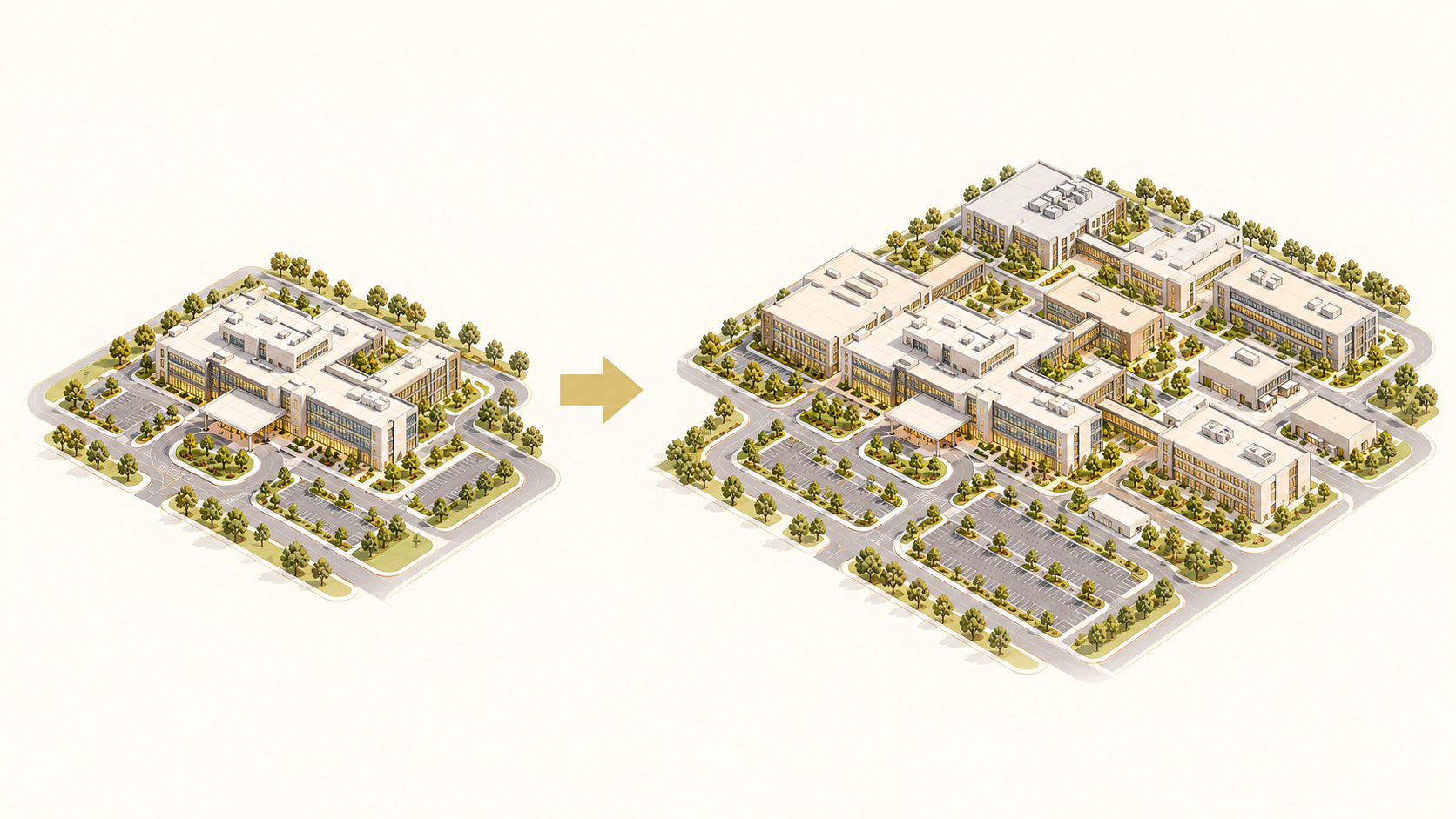
A growing community will not need the same hospital in ten years. Phasing lets you open at a size the market can support today, while protecting the ability to add beds, theatres or a specialist block later. Practical measures include oversizing main plant rooms and risers, reserving “soft” space such as offices that can convert to clinical use, and placing departments that grow fastest at the building’s expandable edge.
class="attachment-full size-full wp-image-7359" alt="" srcset="https://www.hospertz.com/wp-content/uploads/2026/10/hospertz-phased-hospital-growth-v2.png 1672w, https://www.hospertz.com/wp-content/uploads/2026/10/hospertz-phased-hospital-growth-v2-300x169.png 300w, https://www.hospertz.com/wp-content/uploads/2026/10/hospertz-phased-hospital-growth-v2-1024x576.png 1024w, https://www.hospertz.com/wp-content/uploads/2026/10/hospertz-phased-hospital-growth-v2-768x432.png 768w, https://www.hospertz.com/wp-content/uploads/2026/10/hospertz-phased-hospital-growth-v2-1536x864.png 1536w, https://www.hospertz.com/wp-content/uploads/2026/10/hospertz-phased-hospital-growth-v2-133x75.png 133w, https://www.hospertz.com/wp-content/uploads/2026/10/hospertz-phased-hospital-growth-v2-1200x675.png 1200w, https://www.hospertz.com/wp-content/uploads/2026/10/hospertz-phased-hospital-growth-v2-480x270.png 480w, https://www.hospertz.com/wp-content/uploads/2026/10/hospertz-phased-hospital-growth-v2-24x14.png 24w, https://www.hospertz.com/wp-content/uploads/2026/10/hospertz-phased-hospital-growth-v2-36x20.png 36w, https://www.hospertz.com/wp-content/uploads/2026/10/hospertz-phased-hospital-growth-v2-48x27.png 48w" sizes="(max-width:767px) 480px, (max-width:1672px) 100vw, 1672px" /> A phased master plan lets a hospital grow with its community without demolition.
The bottom line
Right-sizing is an evidence exercise. Define the catchment, decide the service mix, do the capacity arithmetic as a range, test it against realistic payer scenarios, and choose a site that can carry both today’s hospital and tomorrow’s. When those steps are done, the bed number stops being a guess and becomes a defensible decision for your board, lenders and regulators. The next step is turning it into a project plan — see the seven stages from feasibility to opening.
Sources and notes
- Department of Health – Abu Dhabi — Healthcare Capacity Master Plan to guide investors
- Health Act No. 21 of 2017 — incl. PPPs (s.23) and levels of care (First Schedule)
- Office of the President of Kenya — assent to the four health laws (2023)
- Social Health Insurance Act No. 16 of 2023 (WHO legal repository copy)
- ISPOR — Saudi Arabia restructuring healthcare financing and delivery (2024)
- BusinessTech reporting Stats SA General Household Survey 2023 — medical scheme coverage
- WHO fact sheet — Electricity in health-care facilities
Assumptions and recommendations: The bed-calculation example uses illustrative numbers, not market data. Planning recommendations reflect general healthcare planning practice and should be adapted to local evidence and regulations.
Information is general guidance, not legal, regulatory or investment advice. Last reviewed: October 2026.
Frequently asked questions
How do you calculate how many beds a hospital needs?
Multiply expected annual admissions by the average length of stay to get bed-days, then divide by 365 multiplied by your target occupancy. Because each input is an estimate, model a range rather than a single number, and test it against local evidence.
What occupancy rate should a new hospital plan for?
There is no single correct figure. Planners commonly use a target below full occupancy to absorb peaks and allow cleaning and turnaround; the right figure depends on the service, demand variability and whether the hospital handles emergencies. Treat any figure as an assumption to test.
Should a new hospital start small and expand?
Often, yes — opening at a size the market supports today and expanding in phases reduces risk. It only works if the site, structure and engineering plant are planned for expansion from the start.
What matters most when selecting a hospital site?
Access for patients and ambulances, enough land for future expansion, reliable utilities, freedom from flood and ground hazards, and a clear zoning and approvals position.
Does the payer mix really affect hospital size?
Yes. Public insurance rules, private insurance coverage and out-of-pocket affordability determine which services are viable. In Kenya, for example, public funds pay for different levels of care, so the level a facility operates at shapes its revenue.
class="attachment-full size-full wp-image-7351" alt="" srcset="https://www.hospertz.com/wp-content/uploads/2026/10/vishal-Jadhav-26.png 500w, https://www.hospertz.com/wp-content/uploads/2026/10/vishal-Jadhav-26-300x300.png 300w, https://www.hospertz.com/wp-content/uploads/2026/10/vishal-Jadhav-26-150x150.png 150w, https://www.hospertz.com/wp-content/uploads/2026/10/vishal-Jadhav-26-75x75.png 75w, https://www.hospertz.com/wp-content/uploads/2026/10/vishal-Jadhav-26-480x480.png 480w, https://www.hospertz.com/wp-content/uploads/2026/10/vishal-Jadhav-26-24x24.png 24w, https://www.hospertz.com/wp-content/uploads/2026/10/vishal-Jadhav-26-36x36.png 36w, https://www.hospertz.com/wp-content/uploads/2026/10/vishal-Jadhav-26-48x48.png 48w" sizes="(max-width:767px) 480px, 500px" /> Founder and Director of Hospertz. After a career in medicine, Dr. Vishal moved into corporate healthcare and now leads a team of healthcare architects, NABH consultants and project managers who plan and build hospitals, clinics and diagnostic centres across India.
Related guides
Turn this guide into a plan for your hospital.
Discuss feasibility, planning, budget and timelines with the Hospertz team. [Confirm Hospertz service or capability]